
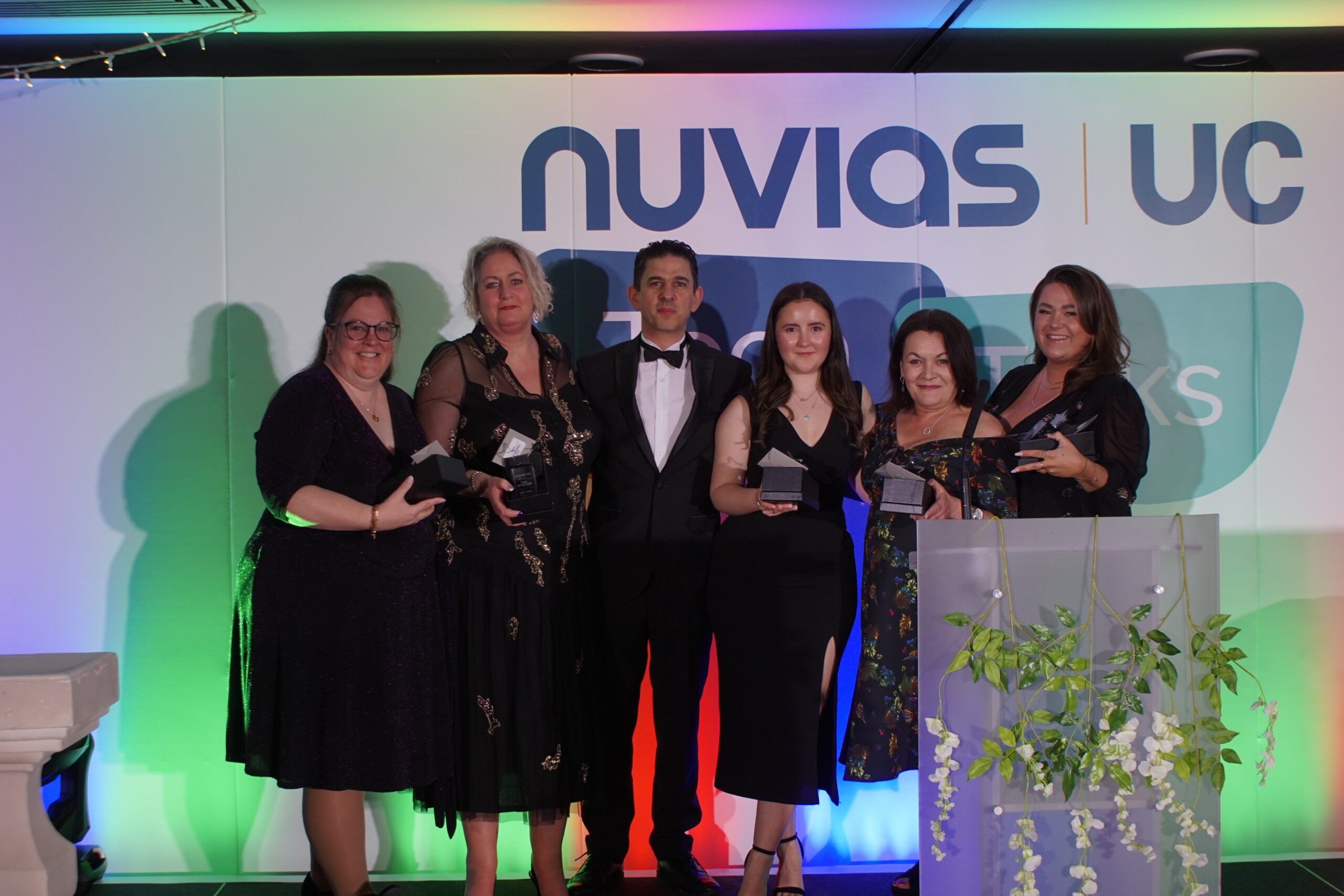
Technology Reseller talks to Joel Chimoindes, CEO of Nuvias UC, about his first 10 months in charge of the specialist distributor of voice, video, UC and CCaaS solutions and his plans for 2024.
In March, Nuvias UC, a Rigby Group business appointed Joel Chimoindes as CEO, taking over from Jeremy Keefe who had led the business for the previous two and a half years.
 Previously Vice President of Maverick AV Solutions Europe, Chimoindes has 28 years’ experience in specialist AV and unified communications distributors, including spells at Imago, under Ian Vickerage; Horizon Technology Group, Tandberg’s first distribution partner anywhere in the world; AVnet, following its acquisition of Horizon; and Tech Data, where Chimoindes had a European role with responsibility for high value areas such as unified communications and cloud, solutions aggregation and professional services.
In 2016, Chimoindes left Tech Data Group to set up the service-led distribution business Beta Digital Media Solutions, specialising in content creation services for digital signage resellers, before rejoining the Group in 2017 as European Commercial Director of its specialist AV business unit Maverick AV Solutions, later being promoted to VP of Maverick AV Solutions Europe.
The opportunity to take up the CEO role at Nuvias UC came at a good time for Chimoindes – he turned 50 in 2023 and was looking for a fresh challenge within distribution.
“I’ve always looked at Nuvias UC and the Nuvias Group as a specialist business and I was attracted to the role because I really wanted to be in an environment where, one, I was testing myself in my first CEO role; and, two, where we could be super-focused and nimble with that. Because I was turning 50, I’d already made a list of things that I wanted next in my career, and Nuvias UC felt like a great organisation to join and help move to the next level.”
Technology Reseller (TR): You’ve been in the distribution business for 28 years. How do you think it has changed in that time?
Joel Chimoindes (JC): I don’t know that it has changed much because, alongside volume distribution, there have always been areas of specialism in distribution – I try to avoid ‘value-add’ because it’s one of the most overused terms in the industry.
When I started out, I was in a specialist distribution business, Imago, and its particular product expertise at the time was in monitors with speakers on the side, multi-headed graphics cards that we were selling into the finance industry, and digital editing cards that cost £5,000 a card. Then we got involved in video conferencing via PictureTel which was deemed very specialist at the time.
My point is that products mature, but while they’re in the early stage of the adoption curve, there’s a space for specialist distribution to help the channel with knowledge, expertise and support services. Then, as those products become more day-to-day, partners take on that responsibility themselves – they skill up, they educate and they deploy their own services. Once they have matured completely, people move on to new areas.
With the exception of video conferencing, those technologies that I referred to as specialisms in 1998 are run-of-the-mill in the IT world now.
So, I don’t think the mechanisms of distribution have changed; specialism is still at one end of the scale and volume at the other, and that’s always been the case. What has changed is the amount of acquisitions and mergers.
Go back 10 years and there were around 30 sizeable AV distributors in Europe. Now there’s probably about eight, and those eight continue to acquire smaller distributors. That has been a big change. Has it been a good thing? As companies acquire, they add focused expertise and customers and, in a lot of cases, profit to expand the business. So, on the one hand, I think it’s great because those businesses can offer scale in more areas, but it can reduce choice in some areas as well.
Coming back to my original statement, I do think there always will be a place for specialism in distribution. And, for us that means making sure that we are the number one go-to partner in those areas where we can enable our partners to reach revenue quicker.
TR: Do you plan to take Nuvias UC into new areas, as other distributors in your areas of the market have done, or are you going to remain focused on existing areas of expertise?
When I joined, I was really clear about what our strategy would be moving forward and how we would stay wedded to that.
Our strategy is based on four pillars, the first of which is telephony. That is the heritage of the business and we still do a lot of work in the telephony sector, especially around more complex areas, for example with Broadsoft.
Second is the video and meeting room space. We all know about the explosion of that market post-COVID, but it’s definitely going through a maturing phase now. Pre-COVID, the addressable market worldwide was about 140 million meeting rooms and that’s now down to 90 million. Microsoft will tell you that only 16% of that addressable space has adequate video, which sounds great as an adoption opportunity, but we’re seeing average sales prices (ASP) come down as well, which means the channel has to sell a lot more in that space to achieve revenue growth.
Our third area is UCaaS, with companies like Zoom. That market is really important to us and is growing at 12-13% CAGR.
The fourth area is CCaaS (contact centre as-a-service). Contact centre technology has been around for 10, 15, 20 years, and CCaaS offers the ability to deploy that in the cloud and provide much better functionality and a much better customer experience. What’s interesting for us is how that technology scales down to the mid-market and smaller companies, which is a much bigger opportunity for the channel. CCaaS is a really big focus for us.
Underpinning all of that is our services capability, which is designed to extend a partner’s capacity or capability in areas where they haven’t skilled up yet. CCaaS is a great example of that.
So, to answer your question, we are really focused on those four pillars and we’re working with our key vendor partners on expanding their solutions inside those ecosystems and taking them to market. But we will be doing that selectively. Our role is not to offer every competing vendor. We want to be super specialist at the portfolio vendors that we bring on in those four technology areas.
TR: How important is your services capability to overall revenue, and is that side of the business growing?
JC: It’s roughly 30% of our business right now and it’s definitely growing. Our service strategy is designed to extend the capacity or the capability of our partners, for example with implementation, migration and device management services.
In Germany, we recently completed a 13,000 Skype for Business to Teams migration at a very large engine manufacturer and are now running a 24/7 managed service for those Teams devices, all on behalf of the reseller.
What we’ve also done is aggregate our services delivery teams across Europe. Before, we had a good service business in the UK and a very service-rich business in Germany from our acquisition two years ago of Alliance Technologies, now Nuvias UC Germany.
From January, our services capabilities are going to be aggregated into one services team across Europe, giving us the ability to scale resources better, address customer needs much faster, and cross-pollinate our services into different regions, including France and the Netherlands where we also operate.
TR: What are the fastest growing parts of your product portfolio now? And do you expect that to continue?
JC: CCaaS is the main area. It is a £1.7 billion business in Europe today and is set to grow at 17% to 18% over the next three years. That presents a lot of opportunities, not just with the CCaaS service but also with the ecosystem that sits around that, whether that’s attaching hardware or delivering implementation services.
And, of course, UCaaS continues to grow. While we’ve seen the ASP for the average seat price come down, the opportunity for continuous deployment around a set of UC solutions is key.
TR: It’s interesting what you said earlier about there being fewer meeting rooms globally. What do you think the future of work is going to be, and what impact might that have on your specialisms?
JC: Without a doubt, we’re in a flexible working mode now. There are numerous benefits to having people in the office – faster decision-making, ‘water-cooler’ discussions, the energy you get from colleagues. Much as I love video technology, it’s very difficult to replicate those benefits consistently over video or UC.
At the same time, employees require and expect flexibility. At Nuvias UC, we favour three days in the office and two days at home (unless we are visiting customers or vendor partners, of course). But I don’t think there’s a one-size-fits-all approach. Every company will be different and the divisions within those companies – finance, operations, marketing etc. – might also be different. So, we will continuously evaluate what we do, especially by division.
The UC market – and let’s use that as a catch-all for telephony, meetings, chat, communications – is going to have to continue to develop to meet customer demands around flexibility and work. The growth stats for Teams and Zoom show how far that’s come already. And that will continue to grow.
The next leap is around AI. We spend a lot of time talking about AI, the technology, and perhaps not enough time talking about the gain for people, which is increased productivity.
In our business, we’ve already started to implement things like Copilot and Zoom AI to be able to summarise meetings, which is a fantastic tool, and we’re also using AI for data analysis and data crunching.
We’re a great example of how CCaaS is now a solution for businesses of any size, not just (very) large enterprises As we deploy a new CCaaS solution internally, we can start to use AI to build great customer interactions that feel very natural and help customers get the answers they want really quickly. We can also use it to improve our sales capability. As we bring new people into the business, AI can help us analyse the sales calls they have and provide advice on how they can do better next time.
What we’re doing is obviously being replicated by other businesses, so the opportunity for the channel to help customers with AI is phenomenal.
In our industry, especially in the areas that we focus on, the effect of AI on people’s productivity is going to be huge. I often reference a reseller friend of mine who told me that one of the big differences post-COVID compared to pre-COVID is that now, when he goes to an end user to talk about a project, HR is involved in the decision-making process. And HR is involved because they want to understand whether the technology deployment is going to make employees’ lives easier or more complex.
That’s a very different conversation to before, when decisions were with IT and potentially communications, with some input from finance. The portfolio of skills an AV or UC partner now needs to interact with an organisation has changed massively over the last five or ten years.
To start with, a partner basically needed either great AV or great UC skills. Then, in 2007/2008 when devices began to be integrated into networks, that partner needed to develop IT networking and security skills. In 2015/2016, with the birth of platforms like Microsoft Teams and Zoom, partners had to develop platform knowledge. Then, when COVID happened, they had to develop people knowledge as well. That folio of skills has developed massively over the last 15 years.
TR: What other challenges do your reseller and MSP customers face right now?
JC: Stating the obvious, the macro-economic climate has played a big part in decision-making processes this year, especially at an enterprise level.
When you have solutions that start to mature, like in the collaboration space, demonstrating your value in that space can become harder. If an end user can buy a solution for £1,000 from an online e-tailer, a specialist integrator really needs to be able to justify their value to the end user.
So, we’ve got a maturing of the market in certain areas, and we’ve got new areas like CCaaS that are starting to come into the mid-market and below. Gaining skills and knowledge in those is going to be absolutely key.
TR: How have these challenges affected your business over the last year?
JC: We’ve had a tough year because the market has been tough for our partners and our vendors, and because we’ve been through a transition in the last 10 months.
I’ve come in and we’ve brought on board a new team, a CFO and a CIO who have helped to transform our logistics capability and implement a digital transformation strategy. Most recently, Wayne Gratton has joined as CCO to ensure a seamless flow between vendor management, marketing and partner enablement to help partners and vendors get to revenue quickly.
TR: What has your digital transformation programme involved?
JC: We are rebuilding our automation platforms from start to finish, from quote all the way through to order and invoice, to make sure we have more people focused on partner and vendor development than on processing pieces of paper.
We have an ERP upgrade as well which, combined with our implementation of CCaaS and AI, will really help with automation and productivity.
TR: What are your other targets and priorities for 2024?
JC: At a technology level, to expand our ecosystems around the meeting space, UCaaS and CCaaS, and to expand our services capability there as well.
We will continue to evolve the operations side of our business, our digital transformation, and we are launching a new channel enablement engine, Pathfinder+, to help partners make money in areas they may not have invested in before, like CCaaS.
When you work with vendors on new partner acquisition, they will often ask you to find 100 partners to sell their solution. That can be quite easy to do, but the reality is it rarely generates the desired revenue and opportunity. Pathfinder+ is a nurture programme where we work with new and existing partners to provide them with the skills, the capability, the resources and the opportunities to help them get to revenue in new areas.
We’ll run that with specific vendor partners and work with our reseller community to identify partners that want to grow and develop a business in specialist areas. This is very different from just recruiting 100 partners. It is a much more measured approach to generating opportunities that we can nurture and grow together.
It’s something I’ve done in previous businesses and when you’re patient and get it right, it’s really beneficial for the reseller, vendor and the distributor, especially in new areas of business and especially, as we talked about earlier, when times are tough.
Another priority is to continue to aggregate our different geographic businesses together to build a ‘one Nuvias UC’ team and to create a culture in which everybody has a voice, everybody feels included and everyone can contribute to the business. So far, we’ve done a lot to make sure there is trust throughout the business, because when you have trust you can do anything.
The other priority for me is creating an environment where people enjoy coming to work, no matter how tough it can sometimes be. Creating that environment for our people is absolutely key.
TR: You’ve mentioned the success of your acquisition of Alliance Technologies in Germany. Are you considering M&A to expand your geographical coverage and gain additional capabilities?
JC: M&A is never out of the question, but it’s not a focus for the short-term. Through the regions in which we operate today – the UK, DACH, Benelux and France – we already address 75% of the European market opportunity in UCaaS, CCaaS and meetings. So, our main focus this year is to be super-focused on our strategy and our capability in existing territories.


Be First to Comment