
New supercomputing deployments, AI for Science platforms, quantum collaborations, HPC support in networking and open-source software bring heterogeneous computing to the most demanding challenges.
At Supercomputing 2026, AMD is demonstrating how open, heterogeneous computing is expanding the frontier of scientific discovery. Across the world’s leading supercomputers, new AI Factories and emerging quantum-classical systems, AMD is bringing together leadership CPUs, GPUs, networking, adaptive computing and open software to help researchers solve larger problems and move from questions to answers faster.
Powering the World’s Leading Supercomputers

Today’s TOP500 and Green500 lists of the world’s most powerful supercomputers demonstrate the scale of AMD leadership across global supercomputing. AMD powers four of the world’s 10 fastest supercomputers and four of the 10 most energy-efficient, with AMD technology in more than half of the Green500 top 50.
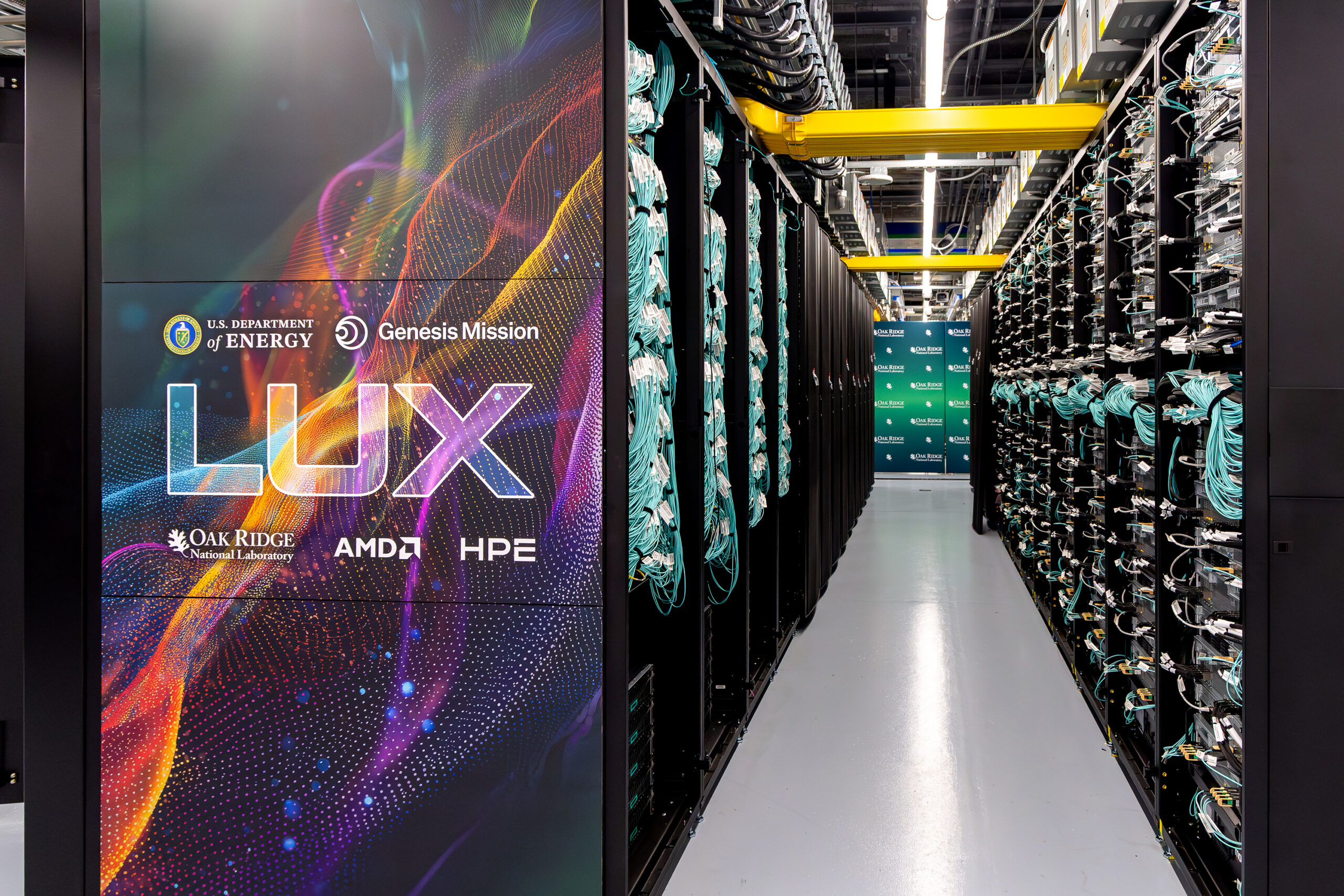
AMD technology powers 202 TOP500 systems – more than 40% of the list and an approximately 14% increase year over year – and half of all new entries. Leading systems include El Capitan (No. 2), Frontier (No. 3), HPC7 (No. 6) and HPC6 (No. 8). Lux debuts at No. 14, delivering 220.79 petaflops of measured HPL performance.
Together, these systems demonstrate the performance, energy efficiency and architectural flexibility required as scientific computing expands beyond traditional modeling and simulation to include AI-driven discovery.
Launching the First AI Factory for the DOE’s Genesis Mission
AMD announced that the Lux SI + HPC supercomputer is open to scientific users at the U.S. Department of Energy’s (DOE) Oak Ridge National Laboratory (ORNL).
Ranked No. 14 on today’s TOP500 list, Lux was developed through a public-private partnership between AMD and the DOE. It provides the first dedicated U.S. AI Factory for the Genesis Mission, the DOE-led initiative to advance AI-driven science.
Lux brings together AMD EPYC™ processors, AMD Instinct™ MI355X GPUs, AMD Pensando™ networking and AMD ROCm™ software in a system built by HPE. The system combines AI with high-performance modeling and simulation to expand U.S. capabilities in science, energy and national security.
Lux demonstrates the breadth of the AMD technology portfolio for AI-driven science. Rather than treating AI and traditional HPC as separate computing environments, the system brings AMD CPUs, GPUs, networking and open software together on one platform designed for heterogeneous scientific workflows.



Be First to Comment