

The big news last month was the announcement by DCC Technology that it is getting out of Info Tech and selling Exertis UK & Ireland and its subsidiaries to AURELIUS, a European private equity investor focused on technology & business services, industrials & chemicals and lifestyle & consumer goods.
The sale includes Exertis UK (Business and Consumer), Hypertec, Exertis Supplies, Exertis Ireland, Macro EV, Exertis Supply Chain Services, MTR and Ztorm, but not Exertis Enterprise. This will remain an independent division of DCC Technology, which says it is selling its Info Tech division so that it can sharpen its focus on Pro Tech and Life Tech.
Pro Tech encompasses Pro AV, infrastructure and AI-powered solutions, some of which aligns with Exertis Enterprise’s specialisms in servers, storage, components, networking, infrastructure and cybersecurity products and, increasingly, outcome-focused solutions.
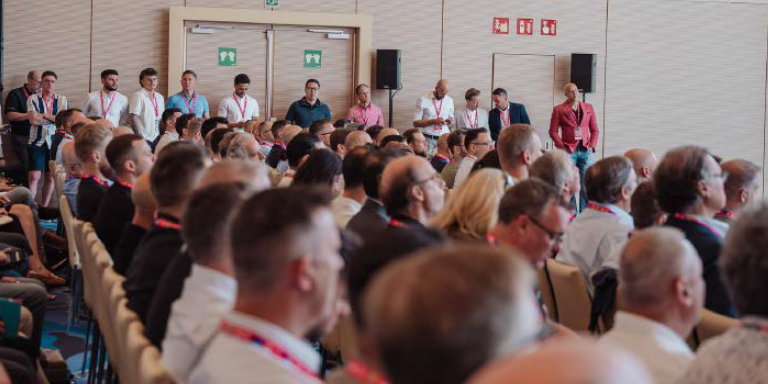
 As Jason Chibnall, Managing Director of Exertis Enterprise, clearly demonstrated in his opening address at the distributor’s first vendor/partner summit in six years, Enterprise Summit 2025 held in the W Hotel in Barcelona on April 28-30, all these technology areas are fundamental to the management of data volumes that are forecast to increase massively with rising AI adoption and the transition to AI reasoning models.
It is still early days, of course, and buying decisions take time to get the green light but Chibnall is confident that the changes Exertis Enterprise has been making over the last few years put it (and its vendors and channel partners) in a good position to address opportunities in infrastructure and AI.
“We’re back to an individual identity as an organisation, and we understand our value. It’s now a case of showing others the value and the differentiators that we have in the distribution landscape,” he said. At the end of April, Exertis Enterprise held its first Enterprise Summit for six years, highlighting its transition from a server and storage distributor into a specialist provider of infrastructure and solutions that will increasingly be relied upon in the age of AI.
At the event attended by 30 vendors and 100 customers, Technology Reseller spoke to Managing Director Jason Chibnall about his plans for the business and how Exertis Enterprise is becoming a trusted advisor to the reseller community Hence the return of the Enterprise Summit.
Key developments in its current iteration are a greater focus on server and storage solutions rather than components and devices, because outcome-focused solutions are essential for solving AI processing challenges; and a broader scope, beyond its heritage in storage, following consolidation with the Exertis cybersecurity division and the addition of four or five new vendors in its server and GPU platform offering.
“We’re beginning to try and fill in the blanks where we haven’t been traditionally with a portfolio of products that people can challenge the market with,” said Chibnall. “If you take cyber security as an example, there are tier one cybersecurity vendors – and you have to win the right to be a tier one distributor.
Then, below that there are probably about 3,000 cyber security vendors to pick from. I’d like to find more tier two and challenger cyber security vendors that will create a much more significant presence for us as a distributor, which will also make us more relevant for a tier one vendor.
“In the server solutions space, again we like to work with vendors that become challenger brands. I’m hoping that by working together we and the new vendor brands that we’ve signed up can push each other up the Challenger stack.”
The other advantage of taking on more vendors is that it has helped Exertis Enterprise manage setbacks including the loss of big customers. “The industry is going through quite a large degree of global consolidation, so you’re seeing a lot of brands trying to streamline their own channel presence and have a leaner cost base to be in the channel (or potentially not be in the channel, in some instances) by replacing a proliferation of local distribution partners with global distribution partners.
We’ve been a victim of some of those strategic decisions. Some of those hurt financially and in certain instances they hurt because of the investment we’ve made in those brands. But we’ve also been having some real success with brands we’ve taken on to fill those holes, where we’re looking at 20%, 30% growth.”
 Exploring AI At the same time, Exertis Enterprise has been investing in its own capabilities to help partners navigate a business climate in which economic uncertainty and the transformative nature of the decisions customers are being asked to make are leading to longer sales cycles, despite the requirement for investment in infrastructure (servers, storage, network, cybersecurity) to cope with massive data growth.
“People are unsure about the economic uncertainties and some of the trade uncertainties that we’ve got, which has put a bit of inertia into their decision-making and their desire to purchase. The next move they make is fairly consequential for a lot of people. It’s not a question of just buying a box; these are long-term decisions.
The sales cycle is likely to be a lot longer so organisations like ourselves have to be much further down the decision-tree when people are deciding what to do.” Chibnall adds that as a result Exertis Enterprise often gets involved with VARs “almost on a joint venture basis”, to fuel each other’s interest in and understanding of how to proceed with technologies, particularly AI.
“The VAR community is typically oriented around how to get a run rate with a set of products. AI isn’t something you can do that with. We are therefore becoming more of a trusted advisor rather than a supplier of products. I extol the virtues of my pre-sales organisation. I know that when my VAR community meets my pre-sales organisation, they often say ‘could you come and talk to us about AI’, with no set outcome expected on either part.
We have no idea where it’s going to take us, but sometimes opportunity presents itself,” he said. “We’ve set up a community of people here in the UK to explore AI. We’ve also invested this financial year in a dedicated sales pod in the UK to explore data centre. We know the growth is going to come from AI, so we’ve set up a dedicated hunting team to go after data centre.”
Recruitment easing When it comes to finding the right talent, Chibnall is more optimistic than many in the technology sector, suggesting that the pendulum may have swung back in favour of employers. “Three years ago, I would have said it was really difficult to find people. Post-Covid, an awful lot of the vendors woke up and wanted to recruit people and as a consequence distribution woke up and wanted to recruit people. We were all competing for a much smaller pot of available resource and all found it challenging to find the right people.
“That balance has now shifted much more towards the employer. Global consolidation has forced a lot more people into the market who are looking for jobs and existing employees are less dissatisfied with the roles they’re in. When we came back from Covid, there was a concept called the Big Move when something like 70% of people in the technology industry wanted to move jobs within the next two years. We saw a pretty healthy movement in our own organisation, and we definitely saw the cost of doing business go up just because of the salary demands that people were making to come and work in the technology industry.
That seems to have stabilised and it’s easier to find people than it was perhaps two years ago.” European expansion A priority this year is recruitment in the Netherlands as part of Exertis Enterprise’s strategic expansion overseas where it has operating companies in six countries, generating around 40% of total revenue.
“We’ve traditionally been a very UK-centric organisation, and this year we’ve elected to try and grow one of our businesses in continental Europe,” explained Chibnall. “We’re investing really heavily in three disciplines in the Netherlands – server storage technologies, component technologies and cybersecurity.
If we can grow in the Netherlands to a significant degree, then we’ll go and do the same in our German market, then in our Belgian market, and just keep repeating what we do. My challenge is finding the quality in that pre-sales conversation, people that can truly represent the vendor portfolio, because it is now about the value that we create, not necessarily how much we can sell something for or how much we’ve got in stock.”
To a degree, Exertis Enterprise is taking a calculated risk and a bet on a future that no one can predict, as Chibnall admits. “If I’m perfectly honest with you, I’m investing in something that I don’t know whether it’s going to give a return, but I know that I can’t just sit and do what we’ve always done,” he said. Moving into services Another area Exertis Enterprise is hoping to develop is the provision of digital services, especially on the cybersecurity side with its recently launched SOC, but also in other technology areas.
“To mobilise a sales organisation used to selling physical products into services and virtual products is quite a difficult shift, but we will offer more and more services, and our vendor community themselves are offering more and more services. We’re trying to take the heavy lift away from partners that don’t really want to build something themselves and almost create a SKU that they can sell.
As part of our capability, we’ve got platforms that perhaps others don’t that can generate monthly billing, operating on a three-tier model: the channel partner can sell it; we can bill the person that they’ve sold it to; and we can then in turn bill the channel partner and contra off what we collect from the channel partner at the same time.
In all of our considerations, it’s always about how we can enable the channel partner.” In the future, this could include AI services. “One of the things we often talk about strategically is our value in operating a bit like an integrator with a distribution card. There’s a whole bunch of software vendors that make up the AI stack, and there’s a need to either find that capability or have partners that can deliver that capability on your behalf, so that you arrive with not just the infrastructure but the software partners that can help enable it.
I haven’t quite worked out yet whether we go on an acquisition strategy to try and find somebody to partner with or find a set of partners that are interested in delivering that aspect while we deliver the infrastructure for them.” In the meantime, Chibnall is hoping that Exertis Enterprise comes to be seen more and more as a trusted advisor to the reseller community.
“Trust is where our organisational value comes from. We have the most long-term relationships with the people that trust us the most. And it always starts life rather similarly, when someone says ‘Can you sell me 100 of something? And what’s your best price?’. We do that, and suddenly they begin to realise there’s more to us than just selling those products and that’s what gives us that long-term business and certainty in our relationships.
Then, as their businesses grow, we grow in line with them,” he said. “We’re of that nice size where we can make contact with most of the vendors and customers at an event like this and are agile enough that if something needs to happen, myself and my board of directors can make it turn pretty quickly. If someone trusts us to do that, we will do it for them.”


Be First to Comment