
Cybersecurity value-add distributor highlights the importance of ecosystems as it embarks on a new growth phase
Cybersecurity value-add distributor the Infinigate Group has taken the integration of recent acquisitions, Nuvias (including Cloud Distribution), Vuzion and Starlink, to the next level with the launch of a new logo and strapline, spark your growth.
As part of the Group’s new branding, unveiled at a partner event held at
The Shard, London and streamed to stakeholders across EMEA, Microsoft cloud distributor Vuzion, which was acquired by Infinigate in August 2022, has changed its name to Infinigate Cloud.
Nuvias/Cloud Distribution (acquired by Infinigate in July 2022) and Dubai-based VAD StarLink (acquired by Infinigate in October 2022) are expected to adopt the Infinigate name at some point in the future. For the time being, however, all three are continuing to use their existing names combined with the suffix ‘an Infinigate Group company’.
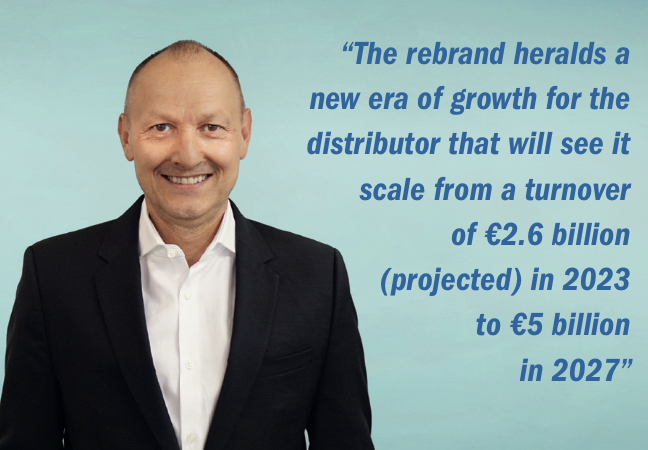
Infinigate Group CEO Klaus Schlichtherle told assembled reseller and vendor partners that the rebrand heralds a new era of growth for the distributor that will see it scale from a turnover of €2.6 billion (projected) in 2023 to €5 billion in 2027 and expand its geographical footprint from 50 countries today to potentially 100 by 2027.
A record of growth
The company’s new five-year Scale phase follows four distinct periods in Infinigate’s history: Foundation (1996 to 2005), characterised by relatively slow growth to €37 million; Specialisation (2005-2010), when the decision was made to specialise in cybersecurity; Evolution (2010-2015), when Infinigate consolidated its position as a specialist cybersecurity VAD, increasing turnover from €131 million to €296 million; and Expansion (2015-2022),
a period of international expansion and rapid growth to €2.2 billion in turnover through a combination of organic growth and acquisitions.
Schlichtherle said that Infinigate had been growing at a CAGR of almost 25% for the last 15 years and that growth would remain the Group’s ‘constant objective’, along with its unwavering focus on cybersecurity, secure cloud and secure networks.
“We have chosen the tagline ‘spark your growth’ because we want to grow with our vendor partners, our reseller partners and our employees. There’s so much opportunity in this market and together we can spark that growth. The cybersecurity market is inherently growing by 11% and we can do a lot more by bringing together the whole ecosystem of customers and vendors and partners and colleagues.”
He said that the new logo reflects this ethos through the use of a lower case typeface to indicate openness and approachability; a variation on the infinite sign, representing infinite possibilities for growth; and the use of two colours – coral and blue – that are said to represent Infinigate’s dual approach of the digital and the human. “That’s what Infinigate is all about,” said Schlichtherle.
Key trends
The value of combining a digital experience (for vendors and resellers) with a human element, was reinforced by Stuart Wilson, Senior Research Director, EMEA Partnering Ecosystems at IDC, who followed the unveiling of Infinigate’s new identity with a presentation on key market trends and their implications for distribution.
He pointed out that despite an uncertain economic outlook, skills shortages, supply chain constraints and the war in Ukraine, end user customers are still focused on IT spend optimisation and are looking to leverage technology platforms to build a more resilient business. He added that this applies even to the two thirds of organisations in Europe surveyed by IDC that are predicting a recession in 2023.
“Only 48% of those who believe there’s going to be a recession say it’s going to have a negative effect on their overall IT budgets. The key point is that for many of these customers that reduction in the IT budget only applies to certain areas. The good news is security risk and compliance investment is most immune from cutbacks. This is really positive for partners that are focused on security, because this is an area where customers can’t cut back.”
Wilson added that in IDC’s European IT Security Survey conducted in May 2022, more than half of organisations cited cyber resilience as a top priority, with one in two increasing their IT security operations budget as a result, due in part to the move to the cloud and the need for enhanced security.
“It’s really vital for partners to understand how customers are thinking about security across their entire technology stack – on-prem and in the cloud. It’s complex for customers and you have the opportunity to help them overcome that complexity, but you have to really position it clearly to them in terms of how you can actually help through tailored value propositions,” he said.
As part of this, Wilson said it was essential for MSSPs to gain a clear understanding of a customer’s business and to be much more customer- led and flexible in supporting their procurement preferences.
“It is no good having a model that you think is best if the customer doesn’t agree. Map onto what the customer wants and be aware of where the customer is going because in terms of purchase options we’re seeing all sorts of new models develop. We’re seeing marketplace environments, for example, taking on a more prominent role. As partners, you need to understand how you fit into these changing ecosystems and changing platforms. The most important point to remember is that you cannot stand still. You have to evolve constantly because the market and customer needs are constantly changing.”
Different roles
Wilson added that the difficulty of recruiting staff with the right security skills meant that end user organisations were increasingly turning to MSSPs to provide that expertise, underlining Schlichtherle’s point about the importance of bringing together an ecosystem of customers, vendors and partners who can work together to meet today’s more complex needs.
 “In the past, one partner could influence the customer, manage the transaction, manage the consumption and then optimise the solution. What we’re now seeing is that multiple partners are playing different roles to serve the same customer at different points in that customer journey. There are partners out there that want to influence but don’t want the transaction or consumption revenue; that’s done by someone else. And you have to start thinking in this way. This new complex ecosystem model creates real challenges, but also real opportunities for partners and distributors. What are you going to focus on? What is your role? How are you going to be the best at that? How are you going to work with other partners to complete the offering for customers?”
Wilson described distribution as ‘the glue’ within multi-vendor, multi partner ecosystems, highlighting the role distributors can play in bringing together vendors to create solutions while also reducing complexity for resellers and enabling them to leverage the distributor’s scale and expertise to boost their own capabilities.
Panel debate
Wilson’s presentation was followed by a panel debate in which he was joined by Klaus Schlichtherle, Frank Koelmel, EMEA Region General Manager, Cybereason and Ben Fallon, VP Global Partner & Commercial Sales, Juniper Networks.
 All panellists highlighted the growing risk of cyber-crime due to the activities
of hackers and the explosion in endpoint numbers, which, combined with increased targeting of smaller businesses and the negative possibilities of AI, are boosting demand for cybersecurity solutions and services.
Schlichtherle said that Infinigate was experiencing greatest growth amongst SMEs that had no choice but to strengthen their defences. “Even though the enterprise business is growing very nicely, the SMB part is growing even more, because a lot of mid-sized companies are getting attacked and awareness is growing,” he said. “There may be a recession looming, but there will be no decline for cybersecurity. On the contrary, it will continue to grow.”
Koelmel, too, sees the SME sector as a big opportunity for vendors and resellers. “Today, a 100-person company is at risk from ransomware, so the problem has become much bigger. With the shortage of skills, there are not enough people and SMBs don’t have the money to invest in their own SOCs or to invest in their own security people. They need help and that is a huge, huge opportunity for us to increase the adoption, the automation and the ease of cybersecurity for this type of customer.”
In answer to the question of whether recent price rises would reduce demand for managed services, Koelmel said: “SMEs are willing to pay a premium because they will make the simple calculation that hiring people, bringing assets into the business is much more expensive than consuming a service. So, we see exactly the opposite; we see a huge trend towards managed services. We also see that with all the security tools customers require, there’s strong consolidation with managed services. You don’t need to buy them; they’re there and can be used and divided amongst 1000s of customers. Instead of looking at price only, SMEs see the value.”
(On this question, Schlichtherle suggested that that the move from Capex to Opex was blurring judgments around the expense of a product: “You need cybersecurity, it’s unavoidable, so the question customers should be asking is how would I like to consume my cybersecurity: should I choose a consumption-based model or buy a three- year licence?”)
Simplifying cybersecurity
Koelmel pointed out that MSSPs also have an important role to play in simplifying cybersecurity and making life easier for customers.
 “The end user has to differentiate between hundreds of solutions. He may have incidents and breaches to deal with. He has pressure from the CEO to get a more secure network and pressure from the CFO to get budgets down. So he has a dilemma. I believe our obligation, together as an ecosystem, is to make it easy for end users to consume cyber security. Cyber security is not a product anymore; cybersecurity is more or less a service that is built up through different building blocks. And combining people’s different strengths would be a great asset in making cybersecurity easier for the end user, making it more impactful and helping to create a more secure world. I think that’s a big, big task in front of us.”
He added: “I dream of a cyber marketplace where you trade all services automatically and combine those services into one end user offering that includes automated security. That’s where I would love to get to in the very short term because that’s how we will help enterprises to become more successful against attacks.”
On the subject of new technologies like AI, he advised partners not to forget the basics, citing two areas where he felt there was still work to be done.
“One, most breaches happen because product solutions and services aren’t configured correctly. This is business we should all go after; it’s low hanging fruit. Number two is looking at consolidation and looking at the tonnes of products customers have. Efficiency is going down; they can’t manage it anymore. This is a huge opportunity for all of us to help the customer to find the right combination of tools to be very effective for the money and the budget they have. That’s something we should engage first before we look at all the sophisticated things, because the sophisticated things will not prove to be successful or unsuccessful if the rest is not in place.”
Innovation
While all panellists were bullish about the growth prospects in cybersecurity, Wilson pointed out that this did not mean the spoils would be shared equally.
“When looking at the growth in security spending, the danger is that everyone will think that applies equally to their business. But it’s not shared out equally. Even if the overall market is growing, there will be winners and losers depending on how people adapt and how people evolve to address the changes we’re seeing in ecosystem business models and how customers want to purchase and consume and optimise cybersecurity.”
Ben Fallon, VP Global Partner & Commercial Sales at Juniper Networks, which since its acquisition of Mist in 2019 has developed a thriving enterprise business based on AI, multi-cloud and automated WAN, agreed with the general consensus that the best way to negotiate changes and profit from new technologies and opportunities was to work with others in an ecosystem.
“There is always innovation, that is what drives this industry forward, and with that comes opportunity. There’s an old proverb ‘if you want to go fast, go alone. If you want to go far, go together’. We heard in the IDC presentation that distribution is no longer just the point of stocking and finance. They really are a point of aggregation, and the power of people working together is at the heart of all that change. If people aren’t on board with that, then they’re probably going to miss out on the next wave of what’s going to transform the industry.”
Wilson added that it is important to develop a model that makes it easy for everyone within an ecosystem to share their expertise.
“We talk a lot about partner-to-partner collaboration within the ecosystem, understanding what you’re good at, what someone else is good at and putting your various skills together to create a solution. Customers are becoming more comfortable with that. They want that almost best-of-breed approach from different partners working together to build a solution. But when we think about the ecosystem, we’re thinking about the vendor role, the distributor role. It is about maximum utilisation of the resources and skills available within that ecosystem. You don’t want partners with spare capacity in a high demand skill; they need to be plugged into the ecosystem so that other partners that don’t have that skill can access that resource as well.”
Digitalisation
Schlichtherle, who likened distribution to a gear-box between vendor partners and the marketplace, said that Infinigate was helping to achieve this by investing a great deal in digitalisation to make processes more efficient and to offer a digital experience to the customer, while also accommodating the human factor that is such as key part of the company’s appeal.
“A lot of people talk about marketplaces. A marketplace is where you offer products but you’re not actually selling, so the value-add of a distributor needs to be digitalised. There needs to be a digital experience for the customer when they purchase the product and there needs to be some value-add element in there as well. The big trend in distribution is to turn our model into a digital model with value add and the human factor on top of that.
“Doing that is very complex. We have 160 vendor partners and everybody has a different approach, so to put them into this gear box is quite challenging. Whenever you have 160 go-to-market models that you need to put into one digital world it takes a bit of time, but step by step it will happen. Customers want to have a digital way of purchasing product and at the same time experience a value-add when they go digital,” he said.


Be First to Comment