
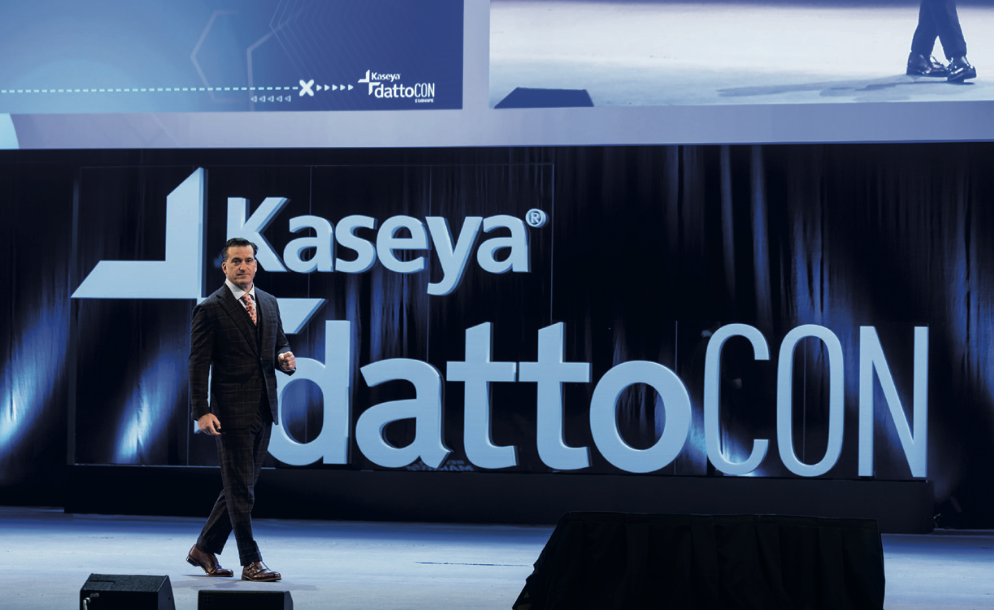
On June 26-28, Kaseya, a provider of unified IT management and cybersecurity software for MSPs and small to medium- sized businesses (SMBs), held the first combined Kaseya DattoCon Europe event since its $6.2 billion acquisition of Datto in 2022. Held in the Convention Centre Dublin, Ireland, the event gave many hundreds of IT professionals from across Europe the opportunity to hear about the company’s product development and future plans.
For CEO Fred Voccola it provided an opportunity to admit that Kaseya does get things wrong from time to time, and would continue to get things wrong, before pointing out that less than 1% of customers have been affected by problems with billing and other integrations since the Datto acquisition. He added: “Keep giving us feedback and we will get better.”
This statement came at the end of an opening keynote, in which Voccola outlined the thinking behind Kaseya’s core proposition, referencing four challenges faced by multi-functional IT professionals within MSPs and to a lesser extent the IT departments of end user organisations (this direct business accounts for about 10% of Kaseya’s revenue).
Kaseya research suggests that customers typically use 17 different products and tools from multiple vendors, each with different interfaces, licensing, contracts, billing and invoicing requirements. The challenges this presents include:
+ Time and expense in managing multiple vendor relationships.
+Lack of integration between products. Here, Voccola made a distinction between ‘cosmetic integrations’ which are superficial and often short-lived and much deeper ‘workflow integrations’ which he suggests are only possible when one vendor owns both sides of the transaction.
The example he cites is copying and pasting an Excel spreadsheet into a PowerPoint presentation, which is so integrated that both elements will be spellchecked together.
+Increased learning requirement. Voccola points out that with 17 products generating monthly updates, each with around 15 items, an engineer will have around 3,000 new things to understand every year. An impossible task, he says. The upshot is that 70% of enhancements never get used or acted upon, which has implications both for productivity and security.
+The cost of running multiple products. Kaseya research shows that 22% of MSPs’ profit is spent on the software and tools they need to run their business and generate revenue.
“Voccola claims that Kaseya charges 30% to 50% less per module than other providers because its growth model is to get its 55,000 customers (growing by 5,000 to 6,000 every year) to buy and use more of these modules”
Kaseya’s answer to these problems has been to create a purpose-built platform,
IT Complete, that provides almost every element of security and IT management from one vendor.
IT Complete
IT Complete 2.0 includes 40 modules across six suites – endpoint management (RMM), data networking, security, back- up, audit & compliance, IT operations (PSA and service desk) – accessed and managed via a single portal, Kaseya One. There are more than 1,000 integrations between the different modules, including all Datto products, and Kaseya adds 15 to 20 every quarter. For European partners these include a new ConnectBooster integration to simplify billing processes for MSPs.
These integrations enable much higher levels of automation, helping MSPs to become 20%-30% more efficient, says Kaseya, while also helping them to cut costs – effectively to do more with less. Voccola claims that Kaseya charges 30% to 50% less per module than other providers because its growth model is to get its 55,000 customers (growing by 5,000 to 6,000 every year) to buy and use more of these modules.
As he told Technology Reseller: “One of the big values that customers get with IT Complete is the integration between the different modules. For example, our security suite is seamlessly integrated with our backup suite – backup being the last line of defence against a security incident or a ransomware attack. It’s so seamlessly integrated with the software that’s protecting them that if someone’s leveraging our security suite, they’re eventually going to use us for backup. And if they’re using security and backup, they’re going to want us for automated documentation, because we integrate so deeply with their security suite and their backup suite. And they’re going to want to use us for RMM because they will want endpoints to be managed through the business rules they build in documentation.”
He suggests that by using the Kaseya stack, MSPs can reduce the amount of profit they spend on software from 25% to 15%. There will be MSPs that don’t want to give up the tools they’ve been using and investing in for 10 or 15 years or who prefer not put all their eggs in one basket and run the risk of getting locked into one vendor that might be hard to break from if it changes terms or fails to deliver expected levels of service or support.
To counter these objections, Kaseya keeps going back to the savings that customers can make by using ever more modules in the Complete IT platform. Ranjan Singh, Chief Product Officer at Kaseya, suggests these are particularly persuasive for some of the larger MSPs owned by private equity firms.
“They have investors and for them it’s about profitability, so we go through an exercise with them called Profit Fuel. It takes about two to four weeks and mainly involves information gathering. We provide a spreadsheet pre-populated with different tool categories and competitive tools and ask the MSP to plug in what they’re paying on a per seat, per month basis and compare that total spend to the cost of corresponding Kaseya tools. On average, customers can save 30% of their spend if they switch to the Kaseya toolset. If you want best of breed or don’t want to put all your eggs in one basket, that’s OK but at the very least your investors should know you’re giving up 30% in profit. People aren’t going to switch instantly, they have existing contracts etc., but it gives them a window into hard dollar savings, never mind the benefits of the commercial integration and the technical integration.”
New features and capabilities To support this model, it is incumbent on Kaseya to keep up with MSPs’ changing needs and advances in technology through a combination of organic development and acquisitions – Voccola told Technology Reseller that Kaseya aims to stay six months to one-year ahead of customer demand in its choice of companies to acquire so that it has time to integrate them into its platform before launch.
Singh added: “As part of our M&A exercise, our goal is on day zero to be fully integrated, commercially integrated and technically integrated. That’s our goal, because that’s where the value is. If you’re selling an independent tool, you’re effectively competing with similar tools. The value to the customer is not only from the tool, but in the fact that it’s integrated.”
Kaseya DattoCon gave customers the opportunity to learn about the company’s latest acquisitions and enhancements, which are not all technology-related but also include products, services and offerings that can help MSPs manage their business, grow sales and develop stickier customer relationships.
In this context, one of the big announcements was the offer of cyber insurance at a below market rate for MSPs and their customers that use all five products within the Kaseya security stack.
“We’re working with a cybersecurity insurance provider that has agreed to the underwriting guidelines that if a service provider or a company is being protected by the Kaseya security suite, they will provide them with $1.5 million of cover for about 40% below market rate,” Voccola explained to Technology Reseller. “We’re not reselling it, we’re not an insurance broker, but when a partner, an MSP, logs into Kaseya One and then goes into the cyber insurance piece, Fast Track, it tells them if they’re eligible or not based on what modules they own. If they are eligible, they press a button, it submits that right away to the insurance provider and they come back with the policy.
“The other part about this is that if you’re an MSP and you’re on the Kaseya security stack. First, you can get this insurance for your own business and second you can go to your customer, say Kate’s architecture firm, and say ‘Kate, because I’m your MSP and I’m using the Kaseya security suite to protect your business, you can get your cyber insurance at 40% less’. That’s huge for the MSP and by the way, if Kate’s architecture firm decides I don’t want to work with my MSP any more, they’re going to have to give up that cyber insurance. So it makes customers stickier.”
This is one example of how the different elements of Kaseya’s ever growing offering – the technical products, the services, the sales enablement and business management tools for MSPs – intersect to strengthen MSPs’ business proposition and capabilities.
Others include the acquisitions of: nVonahi, which provides automated network penetration testing for 10% of the cost of specialist consultancies and in a fraction of the time. “The pricing model is such that you can run it every month, so we’ve democratised doing network penetration testing, and you get the report within 48 hours,” said Singh; and audIT, a sales proposal and presentation tool developed by an MSP for MSPs, for which Kaseya is giving every MSP five free licences.
Voccola told Technology Reseller that as well as enabling very professional customer engagements, audIT addresses a problem faced by many MSPs, what he calls the ‘information asymmetry’ between a technical person and a non-technical person, which he says is greater than that between a surgeon and a patient. On the positive side, this ‘asymmetry’ means that people unquestioningly do what IT/ security tell them to. On the downside, it can mean people are unaware of all the work an MSP does to keep a business secure. audIT uses a nine-box grid and traffic-light colour coding to show where an MSP is providing protection (green), where there are gaps (red) and where protection could be strengthened (orange). He suggests that as well as being a useful sales tool, this allows a non-technical person to really understand and appreciate the value of an MSP’s activities.
Notable product announcements, in addition to IT Complete 2.0, include Datto Endpoint Backup for Servers, giving MSPs the option to protect servers directly to the secure Datto Cloud; Microsoft 365 Management in Datto RMM, enabling technicians to diagnose and solve the most common user issues across all their M365 tenants directly in RMM; the relaunched Datto Networking Appliance (DNA), a high- performance network router for ‘always on’ internet connections with fully integrated 4G LTE failover; and Universal Ransomware Rollback (included with Datto Endpoint Detection and Response), which gives the ability to detect and revert encrypted files back to their original state and restore deleted files, such as those hit by a wiper attack or deleted by accident.
Looking to the future, Kaseya has been addressing the skills challenge facing MSPs with the launch of the Remote IT and Security Management (RITSM) 40- hour certification programme. Delivered in partnership with 50 universities and 100 private educational organisations, RITSM aims to create a community of technicians trained in Kaseya products, with a target to certify 5,000 by the end of this year and 100,000 by the end of 2024.
AI for automation
AI is another way in which Kaseya can improve skills levels and knowledge of its solutions. One year ago it launched its first major AI initiative, Cooper AI, to help customers use its products better and more extensively. Cooper (named after Voccola’s dog) does this by monitoring user activity and providing insights into how they can do things more efficiently and more securely.
“An MSP has to deal with so many things at once without the infrastructure that an HSBC has or a Royal Bank of Scotland or a Rolls Royce has,” explained Voccola. “An MSP doesn’t have a dedicated group of people to monitor their tools and ensure they’re trained on them, so we built Cooper to do that. And he’s free. It’s like having a constant training and management and best practices organisation making sure you have the best chance to be successful and making sure you don’t do something that can hurt you, like leaving a security setting undone. Cooper will say ‘By the way, you should do this. If you don’t know how, here’s a link to the video that shows you how and here’s how you can sign up for training to get certified’.
“Cooper also looks at the people using the Kaseya platform. If you hired a new person yesterday and that new person logs into the Kaseya platform, Cooper will look at what certifications they have and will send the administrator a note saying
Alex has logged on to your platform and she hasn’t been trained or certified for the things that she’s using. Here are the links to get her online training and here’s the link to schedule Zoom training because, as we both know, IT and security done incorrectly can be dangerous.”
Voccola is keen to distance Cooper from the much mocked Microsoft Clippy, pointing out that it doesn’t need to pop up all the time and can be scheduled to show its insights at a time of your choosing, for example at the end of the day or the end of the week. He adds that unlike Clippy, Cooper has already demonstrated its value to MSPs, citing figures showing that MSPs acts on 42% of the 24 insights that Cooper typically raises for each organisation.
In the future, he expects Kaseya to make greater use of AI, bringing even more benefits to customers. “Cooper was our first major AI initiative and you’ll see a lot more leveraging of AI-based technologies. We do a lot of automation and AI is great for enabling automation. I think that’s going to allow MSPs to serve more endpoints per technician, earn more revenue per technician and serve more customers per technician. Thirty-six months from now, our platform will make an MSP 150% more efficient,” he said.
AI for automation
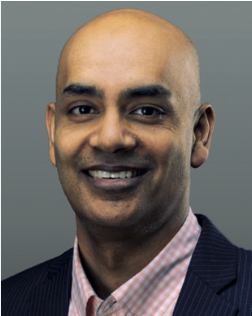
How is Kaseya planning to make use of AI in its products and when can we expect to see further developments in the AI area? We put this question Ranjan Singh, Chief Product Officer at Kaseya.
Ranjan Singh: “I can give you some simple examples that I would call low hanging fruit. Think about a customer getting incoming tickets, service requests. About 60% of them are repetitive – reset my password, I can’t login to this account, I can’t access this, the VPN router is down. These are common, repetitive tasks that the likes of Chat GPT can
really automate.
“So, one area we are exploring is the natural language processing of incoming tickets. You write your ticket request in free-form English or whatever your local language is. We analyse it and because we know how to automate certain actions, we’re able to automate those tickets. This way you can reduce the technician’s workload by about 60%. That’s the first area.
“Another area is around our IT Complete platform and the data we have across its modules. Feed that data into an AI engine and the insights get richer. Today, our insights are focused on individual modules. When we start looking at insights across modules, we might see that you have a consistent pattern of working between, say, three modules to solve a particular issue. That gives us insight into what to automate. We can go in and automate those functions.
“Microsoft are going to come out with Copilot. Many in the SMB segment are highly reliant on M365 and we see some opportunity there too. We can co-locate ourselves in the Copilot environment, which will enable our customers to, if you like, go outside the IT Complete platform to automate the onboarding of a new user – go to Microsoft, purchase a licence, configure the user, configure their endpoint via RMM. You can literally automate the entire stream.”
So you don’t see AI as a threat in any way?
Ranjan Singh: “Oh no, not at all. It’s all about driving efficiency for the technician. Our customers will get more profitable because that same five-person shop can now deliver services to maybe five times as many customers. We are leading the space in building integrations and AI will only make us more efficient both in building integrations and in automating functions that customers are looking for.”
When might we see further developments from Kaseya in this area?
Ranjan Singh: “It could be towards the end of this year. At the moment, I’d say we’re still in the research phase, the proof of concept phase. That said, we already have Cooper AI; that’s already there. We also have Graphus, an automated phishing defence platform for email, which has its own AI engine. So we have AI engines scattered around IT Complete. This is about enhancing those AI engines to look across modules.”


Be First to Comment