
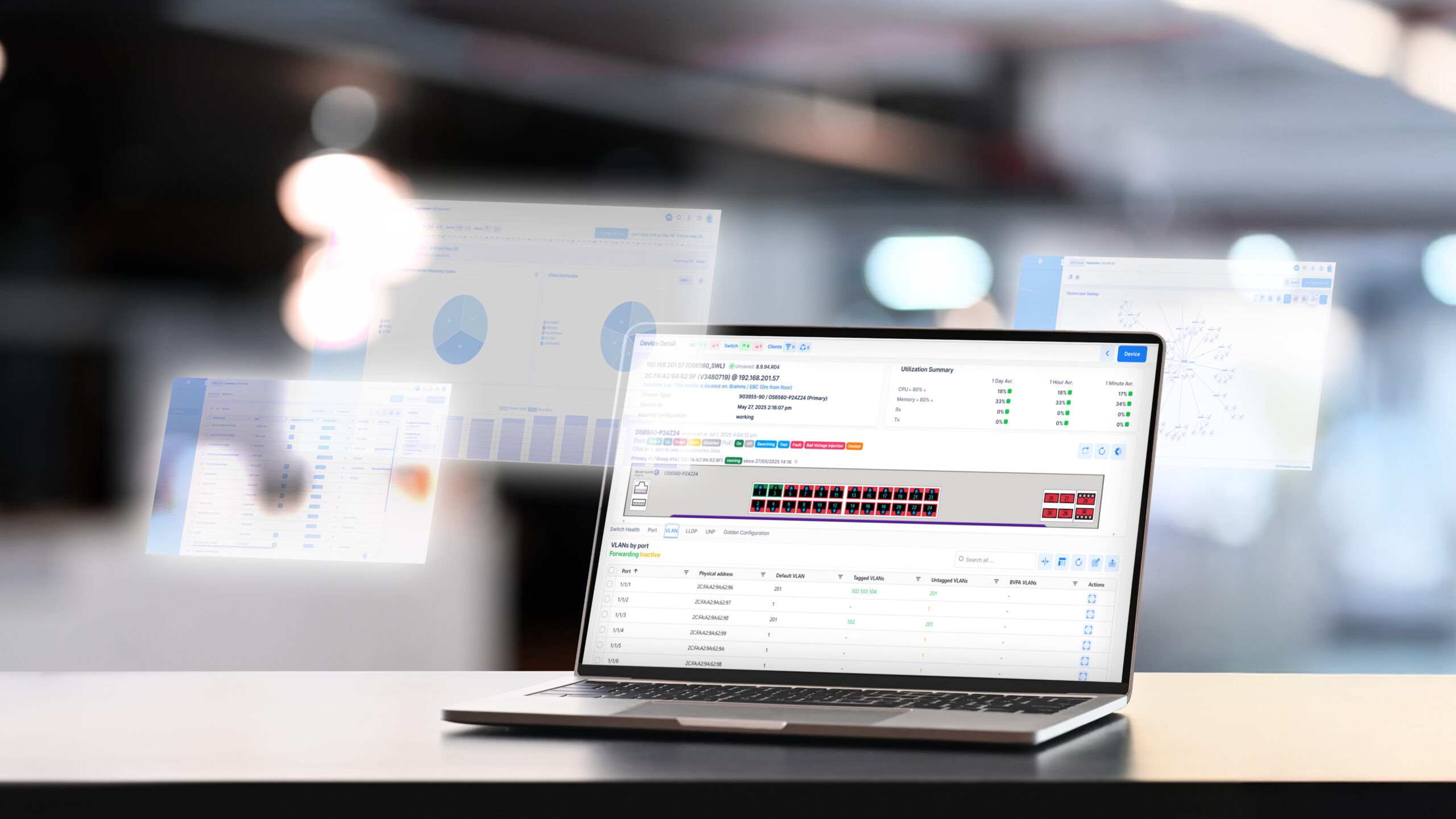
In this Q&A, Gerry O’Hanlon, Country Business Leader for UK and Ireland at Alcatel-Lucent Enterprise, explains how the company’s new on-premises network management platform gives customers in regulated industries more choice and control
Q: Alcatel-Lucent Enterprise has just announced OmniVista Terra, a new on-premises network management platform. Before we dive into the product specifics, can you set the context for us. What’s happening in the network management market right now?
Gerry O’Hanlon: What we’re seeing across the industry is quite remarkable, and frankly, concerning for many IT leaders. Major vendors – Cisco with Meraki, Juniper with Mist and HPE Aruba – are pushing customers towards cloud-only management platforms. In some cases, they’re removing on-premises options entirely. Meraki, for instance, was designed from the ground up with no on-premises controller option. Juniper Mist operates purely in the cloud, with no on-premises controllers available. It’s become the industry’s default direction.
Q: That must create challenges for certain organisations. What are you hearing from IT leaders?
Gerry O’Hanlon: While cloud management makes perfect sense for many businesses, we’re hearing loud and clear from customers in regulated industries – government, defence, healthcare, transportation, energy and utilities – that they simply cannot adopt cloud-only solutions. They face strict compliance requirements, have data sovereignty concerns, or need guaranteed performance with ultra-low latency. These aren’t edge cases; they are massive sectors with specific operational needs that cloud-only vendors are increasingly unable to serve.

Q: So that’s where OmniVista Terra fits in. Can you explain how this differs to what’s currently available?
Gerry O’Hanlon: OmniVista Terra is our next-generation on-premises network management system, and what makes it unique is that it’s not a compromise. We’re not offering a stripped-down version of a cloud platform. Terra delivers the exact same advanced features as our cloud-based solution, OmniVista Cirrus, including unified LAN and WLAN management, AI-driven analytics, intelligent chatbot assistance and comprehensive observability, but it runs entirely on the customer’s infrastructure, under their control.
Q: Walk us through some of those key features. What does Terra actually do for network administrators?
Gerry O’Hanlon: Let me start with the unified management aspect. Terra provides a single, intuitive interface for managing both switches and wireless access points, so there’s no jumping between different consoles and no separate learning curves. You get zero-touch provisioning for rapid device deployment, real-time device insights for proactive troubleshooting and advanced Zero Trust security policies with automated IoT micro-segmentation.
The AI capabilities are particularly exciting. We’ve integrated an AI-based chatbot that lets administrators use natural language to get real-time responses to network queries, configuration guidance and troubleshooting support. It dramatically accelerates problem resolution. And when you pair that with OmniVista Network Advisor, our AIOps tool, you can identify root causes and mitigate issues efficiently across your entire network.
Q: You mention observability. Can you elaborate on that?
Gerry O’Hanlon: Exceptional observability is critical for modern networks. Terra provides deep, real-time analytics on network performance, user behaviour and device status. You get Quality of Experience metrics, historical analysis and Wi-Fi heatmaps for coverage optimisation – everything you need not just to react to problems, but to prevent them. The platform gives you complete visibility into what’s happening across your infrastructure, which is essential when you’re managing complex, mission-critical networks.
Q: I have to ask the obvious question. Why would an IT manager choose on-premises deployment when cloud is often seen as simpler and more flexible?
Gerry O’Hanlon: That’s the critical question, isn’t it? For many organisations, cloud absolutely is the right answer, and that’s why we offer OmniVista Cirrus.
But consider these scenarios: a government agency handling classified information cannot have network management data traversing public internet infrastructure, regardless of encryption; a hospital needs guaranteed, predictable performance for life-critical medical systems and can’t afford latency variations based on internet connectivity; an energy utility managing critical infrastructure needs air-gapped security; a financial institution faces strict data sovereignty regulations requiring all operational data to remain on-premises.
In these cases, on-premises isn’t just a preference, it’s a mandatory requirement. Terra gives these organisations maximum control and data ownership; predictable ultra-low latency; strong local control, ideal for regulated industries; and fixed, upfront operational costs rather than ongoing subscription dependencies.
Q: But doesn’t on-premises mean higher operational overhead, more IT staff, more complexity?
Gerry O’Hanlon: Historically that’s been true, and that’s precisely why Terra is such a significant release. Yes, on-premises requires dedicated, skilled IT personnel to manage the infrastructure, to perform server maintenance and to handle security, backups and upgrades. But Terra dramatically reduces that burden through intelligent automation, simplified workflows and that AI-assisted operation I mentioned earlier.
We’re realistic about the trade-offs. Large enterprises and organisations in highly regulated sectors are our target customers for Terra. They already have the IT teams and infrastructure. What they haven’t had is a modern, intelligent platform that gives them the control they need without sacrificing the advanced features available in cloud solutions.
Q: You keep mentioning that Terra and Cirrus share the same features. Can you explain that strategy?
Gerry O’Hanlon: This is crucial to understand. Terra and Cirrus form a unified network management suite. They’re not different products with different capabilities, but deployment options of the same platform. This means customers get identical features whether they choose cloud or on-premises: the same unified LAN/WLAN management, the same AI-driven analytics, the same security capabilities, the same integration with solutions like Celona Private 5G and Versa SD-WAN.
Organisations can even adopt a hybrid approach, using Cirrus for some sites and Terra for others, all managed under a common umbrella with consistent security policies. That flexibility is unprecedented in the market.
Q: How does this position Alcatel-Lucent Enterprise differently from competitors who are going cloud-only?
Gerry O’Hanlon: It positions us as customer-centric rather than vendor-centric. We’re saying your deployment model should serve your business requirements, not our preferred service delivery method. When vendors eliminate on-premises options, they’re essentially saying to entire market segments like government, defence, critical infrastructure ‘we don’t want your business’ or ‘you’ll have to compromise your requirements to use our product’.
We’re taking the opposite approach. We believe IT leaders should have choice. Cloud makes sense for many scenarios: distributed organisations, rapid growth, limited IT resources, preference for operational expenditure over capital expenditure. But on-premises makes sense for others: highly regulated sectors, data sovereignty requirements, ultra-low latency needs, preference for local control and fixed costs.
Q: Let’s talk about specific verticals. Where do you see Terra having the biggest impact?
Gerry O’Hanlon: Government and defence are obvious candidates. These organisations often require air-gapped networks and cannot have management data traversing public infrastructure. In the transportation setor, airports, rail systems and ports need guaranteed performance for safety-critical systems. Energy and utilities managing power grids, water systems or oil and gas operations require maximum security and control. Healthcare institutions with life-critical medical devices need predictable, low-latency performance. Financial services face strict regulatory compliance around data sovereignty.
The common thread is that these are sectors where network reliability isn’t just about business efficiency but also about safety, security and regulatory compliance.
Q: What about the deployment model? How does Terra actually get implemented?
Gerry O’Hanlon: Terra is designed for virtualised local deployment on the customer’s premises. It can manage up to 5,000 devices (both switches and access points), with high levels of resilience and performance. It runs on VMware with minimum ESXi version 8, requires three virtual machines, and we recommend specific configurations to ensure optimal performance: 8 vCPU, 32 GB RAM, and SSD/NVMe storage per VM.
This isn’t a massive infrastructure requirement. Most large enterprises and regulated organisations already have suitable virtualisation infrastructure in place. We’ve designed it to be as straightforward as possible while maintaining enterprise-grade capabilities.
Q: You mentioned AI and automation several times. How important are these features for making on-premises management viable in 2026?
Gerry O’Hanlon: They’re absolutely critical. The traditional objection to on-premises has been complexity and operational overhead. AI changes that equation fundamentally. The integrated chatbot simplifies daily IT operations; instead of navigating complex menus or consulting documentation, administrators can ask questions in natural language and get immediate, contextual guidance.
AI-based analytics provides proactive insights that help teams stay ahead of problems rather than constantly firefighting. OmniVista Network Advisor identifies patterns and anomalies that humans might miss, helping resolve incidents faster and more efficiently. These features are essential for making on-premises management as streamlined as cloud alternatives.
Q: How does Terra integrate with the rest of the networking ecosystem?
Gerry O’Hanlon: Integration is fundamental to Terra’s design. It provides unified control over ALE switches, wireless access points, IoT devices, Celona Private 5G solutions and Versa SD-WAN and SASE. Everything connects under that common umbrella with consistent security policies and centralised management.
We’ve also built Terra with open APIs, enabling integration into broader ecosystem applications. Organisations can connect it with their existing tools and workflows. This isn’t a walled garden approach; it’s designed to fit into complex, heterogeneous environments.
Q: In terms of the business model, how is Terra licensed and what’s included?
Gerry O’Hanlon: Terra is available through an upfront subscription model with flexible durations: one, three, five or seven years. We offer three service levels – Base, Business and Premium – bundling different levels of support and maintenance.
Base level includes Terra software updates and support access. Business adds Partner Plus support with hardware maintenance and advanced replacement. Premium provides end-customer support access with the same hardware benefits. This tiered approach lets organisations choose the support level that matches their internal capabilities and requirements.
Q: What about organisations that aren’t sure whether cloud or on-premises is right for them?
Gerry O’Hanlon: That’s a great question, and it happens more often than you’d think. Our advice is to start by honestly assessing your requirements. Do you have strict regulatory compliance demands? Do you need guaranteed low latency for critical applications? Do you require complete data sovereignty? Do you have the IT staff and infrastructure to manage on-premises solutions?
If you answer yes to most of those questions, Terra is likely your best option. If you prioritise flexibility, rapid scalability and universal remote accessibility and want to minimise IT operational overhead, Cirrus in the cloud might be better suited. And remember, these aren’t mutually exclusive; you can deploy both in a hybrid model.
Q: Looking at the broader market trend towards cloud-only, where do you see this going? Is on-premises just fighting the inevitable?
Gerry O’Hanlon: I’d push back on that premise. Cloud is absolutely the right answer for many, probably most, use cases. But the idea that on-premises is obsolete is a vendor-driven narrative that ignores real-world requirements in critical sectors.
There will always be scenarios where local control, data sovereignty, predictable performance and security requirements make on-premises not just preferable but mandatory. What’s changed is that historically on-premises meant accepting inferior technology. That’s no longer true. With Terra, you get cutting-edge AI, automation and unified management on your own infrastructure.
The future isn’t ‘cloud versus on-premises’, it’s ‘the right deployment model for the right use case’. That’s what customer-centric means.
Q: Final question: What would you say to an IT leader in a regulated industry who’s been told by their current vendor that they need to move to cloud management?
Gerry O’Hanlon: I’d say you have options and you shouldn’t compromise on requirements that are fundamental to your organisation’s security, compliance or operational needs. The industry trend towards cloud-only is about vendor economics, not customer value. It’s easier and more profitable for vendors to operate a single cloud platform than to support diverse deployment models.
But your job as an IT leader isn’t to make things easier for vendors, it’s to ensure your network infrastructure meets your organisation’s specific needs. If those needs include on-premises deployment, data sovereignty, guaranteed performance or air-gapped security, then OmniVista Terra gives you a path forward without sacrificing modern capabilities.
Network management should serve your requirements. Not the other way around. We’re excited about what Terra means for organisations that have felt under-served by the cloud-only trend. Choice matters, and we’re committed to providing it.


Be First to Comment