
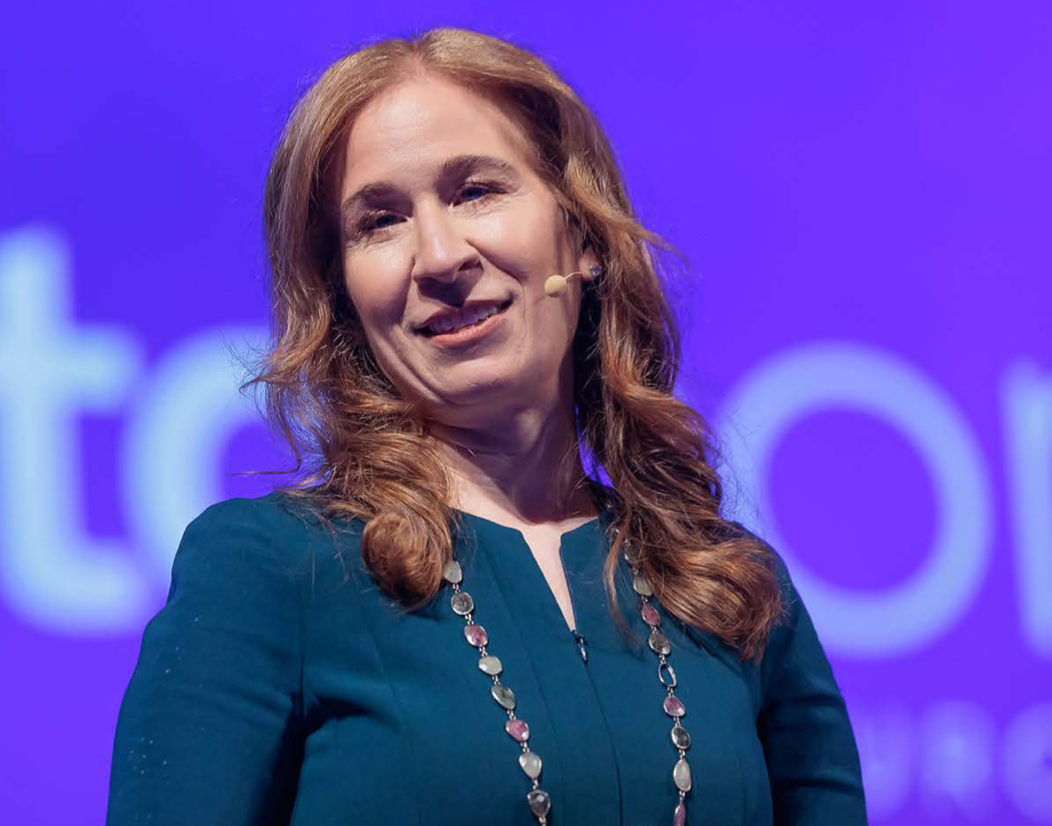
Just two weeks after being named the new CEO of IT management and cybersecurity software provider Kaseya, Rania Succar was on-stage at DattoCon Europe (June 16-18), introducing herself to 1,500 members of Kaseya’s MSP and vendor partner community – a level of engagement she has maintained ever since, taking every opportunity to talk to customers and partners to understand what Kaseya could be doing better and how to build on the company’s ever-expanding, 42-product platform to help MSPs win more business and boost profitability.
Technology Reseller met Succar at Kaseya’s UK Connect Local event at Mercedes-Benz World on September 23 – one of 800 partner/vendor events the company holds every year.
Despite having just arrived on an overnight flight from Miami, Succar was clearly energised by the task ahead and eager talk about the changes Kaseya’s nearly 50,000 MSPs and internal IT department customers can expect to see as she guides Kaseya on the next stage of its ‘journey to IPO’.
Her priorities include a cultural shift to ‘round off some sharp edges’ and make Kaseya easier to do business with – a process Succar says is already underway and producing measurable results – supported by the company’s largest ever investment in R&D (including $100 million in EMEA), with a strong focus on integration and automation powered by AI – areas in which Succar has form from her previous role as Head of Intuit Mailchimp.
Succar is passionate about AI, seeing its emergence as a ‘once in a generation moment’ that will be transformative and disruptive for MSPs and their business customers. Kaseya, winner of the 2025 Technology Reseller Award for Use of AI, is already leveraging AI to help IT pros work smarter, but this evolution is clearly going to accelerate and deepen under the leadership and advocacy of Succar and Kaseya’s newly appointed Chief Technology Officer Pratik Wadher, who helped pioneer AI adoption at Intuit.
Expect Kaseya’s AI plans to be front and centre at Kaseya DattoCon 2025, taking place in Miami on October 6-8, including more details about a new agentic AI platform that will turbo-charge automation when it reaches GA early next year – adding digital workers on top of Kaseya’s end-to-end platform and integrated data layer.
Kaseya’s growth to date has been powered by numerous acquisitions – four or five a year – and Succar says these will continue to be a major growth driver in the years ahead. What’s different now is that the company’s M&A strategy will be supported by more in-house product development and more investment in acquired products (something critics says it has failed to do in the past) to ensure Kaseya customers enjoy industry-leading technology and the productivity and financial benefits of an integrated, end-to-end platform enhanced with agentic AI.
Technology Reseller (TR): You have a strong background in business software from your time at Intuit but are new to the MSP sector. What learnings and insights from your time with Intuit might inform Kaseya’s development under your stewardship?
Rania Succar (RS): While I’m new to the MSP sector, I’m certainly not new to the small business space. I was attracted to Kaseya because of the opportunity we have to make a massive difference
for small businesses. This is a once in a generation moment, with everything happening in AI, and small businesses need to be completely retooled in this moment to be able to take advantage of this transformation. I believe Kaseya, along with managed service providers, can play a tremendous role in that transformation, and that’s what drew me here.
What I bring from my past experience is several things. One, a deep understanding of small businesses and how to build industry-leading software for them. MSPs, in many ways, are small and mid-market businesses as well, so not only do I understand the end customers that they serve and
what they need, but I also understand what MSPs need as small businesses themselves, in terms of the challenges of scaling a business, running a business, acquiring customers, managing cash flow, managing software from so many different vendors and trying to integrate it and put it together. Those are all very familiar challenges.
Second, I understand what it takes to innovate at scale and create some of the world’s most powerful software technology platforms, and that’s our ambition here too. We believe that Kaseya can be one of the most important technology platforms for the small and mid-market sector, specifically around IT management, security and AI, and we intend to keep building on Kaseya’s strengths to achieve that.
TR: To what extent, are you planning to develop the smaller side of your business that sells directly to the IT departments of SMEs?
RS: We exist because small businesses need help managing IT, security and AI, and that’s never been more important than it is today, especially as they prepare themselves for the AI transformation.
But we believe one of the best ways to help small businesses is through MSPs. Small businesses don’t just need great software, they also need trusted advisors to make it happen. That’s a very important part of our strategy, and why we are so excited to be the top partner to MSPs.
We do have a direct offering to small businesses when they choose to manage IT in-house, through their own IT department, and we do serve them in those cases. But for the majority of small businesses that choose to outsource we work through MSPs because we believe that’s the right solution for small businesses.
TR: As AI automates more tasks, do you think small businesses might be able to bring more stuff in-house and what impact might that have on MSPs?
RS: We’re very excited about what this transformation means for MSPs. We believe MSPs will look very different in the next few years to how they look today, and we’re excited to play a lead role in helping them get there.
In the next 12 months, MSPs will fully automate so much manual labour, and Kaseya will be the lead partner in helping them do that. There’s tons of room for innovation in automating tier one repetitive tasks through the introduction of a very sophisticated digital worker capability and we’ll also help MSPs automate their growth activities so they can grow more and attract new customers, again with what’s possible with AI. We think MSPs, even in the next 12 months, will be dramatically different to what they are today.
Then, to answer your question, in the coming few years, we think that once they have done all that work to automate all those repetitive tasks, MSPs will have the capacity to enter the next wave of trusted advisory for small businesses, which will be enabling small businesses to take advantage of what’s possible in AI and business intelligence.
Right now, enterprises are generating all the attention around agents and AI. It’s not a top conversation for small businesses today, and it’s actually been very hard for enterprises to take advantage of it, let alone small businesses. Small businesses are going to need partners in this, not just solutions, but partners who can help them navigate. And we’re going to partner with MSPs to help ensure that they’re the ones at the table driving that transformation. So, I do think some of what MSPs are doing today will be automated, but that’s an opportunity for them to get into the next horizon of impact.
TR: How difficult is it for MSPs to provide that sort of consultancy?
RS: Today, it’s very difficult and that’s why they’ll need a partner like Kaseya.
Number one, we’ll be working on building the agents that are vertical- specific, which small businesses will ultimately need, and curating them for MSPs in a marketplace that they can easily tap into and provide to their SMBs. These will all be built in a very secure, scalable way. Then, we’ll also be doing all the enablement for MSPs to ensure they are at the forefront of that capability. That’s a huge part of our growth agenda.
The change and the transformation required and the need to iterate and invest in AI mean it won’t be easy for MSPs. That’s why we’re committed to partnering with them on this journey.
TR: Kaseya is open about being on an IPO journey. What does that involve and how will it affect Kaseya and its customers?
RS: I think it will continue to be very good for MSPs, because to thrive in the public markets, we need to be one of the most consequential innovators in technology.
Public markets reward tech companies when they don’t just have growth today, but have durable, consistent, repeatable growth and growth rates that accelerate over time because their innovation portfolio is so deep. We intend eventually to thrive as a public company and that means we have to be one of the top innovators for our customers, which will be good for our MSPs.
In terms of our journey to get there, we’ve already reached a scale (more than $1.5 billion in annual revenue) that makes us very material for public markets. This also means that our investment pockets are the deepest in the industry so we’re able to go really deep in innovating on behalf of our customers.
The next few years will be about continuing to invest in our innovation portfolio and all the operating procedures and capabilities that we need to be a public company – all the things you do to prepare from a financial management and a risk management perspective, systems implementation and that type of thing.
TR: Is the $100 million investment in EMEA announced at DattoCon Europe part of that focus?
RS: As I shared in Dublin at DattoCon Europe, EMEA is our fastest growing market and we see tremendous potential in partnering with MSPs to continue to build a thriving SMB sector over here.
We’ve made an investment in local data centres, in expanding into new offices – opening an office in DACH – in localising our offering and in local R&D teams.
We have a big engineering population in Krakow and a big engineering population in Ireland, and we’ll continue to invest heads in engineering here locally.
Obviously regulation in EMEA is distinct and it’s important that we stay ahead of
it, but a lot of our global R&D centres are here too. We see great talent in EMEA and are excited to contribute to its tech sector.
TR: You’ve talked about some of the challenges that MSPs face. What more generally are your first impressions of the MSP community?
RS: I spent a lot of my onboarding time talking to dozens and dozens of MSP leaders and I’ve very much enjoyed my interactions with them.
They are very passionate about serving small businesses, very committed to that, but frustrated by the technology solutions available to them. They want more and they deserve better. In general, the space has an opportunity for more innovation and I’m excited for Kaseya to come in and fill some of those gaps.
Then, they are really looking for partnerships – not wanting vendors but deep partners who are going to help them grow, help them identify new business lines to add, help them activate new customers dramatically faster, and help them create really connected end-to-end customer experiences.
TR: How are you filling the gaps that you have identified in the market?
RS: From my conversations with MSPs it’s clear there are so many things that are still manual that should not be manual.
So many tier one tasks that should have been automated haven’t been, and so much go-to-market tech that would help MSPs grow and move faster if it had been innovated hasn’t been. We are very excited at Kaseya to be narrowly focused on the customer benefits we want to deliver with our roadmap, and we’re already gearing up to have a big impact.
We’re very committed to improving the operating margins of small businesses, and we’ll have some big announcements at our DattoCon conference in a few weeks about how we will be automating these tier one manual tasks in a way that’s very agentic, not RPA, but very agentic, that can be turned on without a lot of engineering effort, enabling MSPs to take advantage of this automation in a much more turnkey way.
We’re also very focused on helping MSPs grow, especially by giving them more security and compliance offerings to add to their toolkit – because SMBs increasingly want those – and by helping create a more flexible commercial model with Kaseya that means when they thrive, we thrive.
TR: Has the uptake of Kaseya 365 subscriptions been in line with your expectations?
RS: It’s been phenomenal (8,000 out of 40,000 customers worldwide, so far – Ed). We’ve helped MSPs save $2 billion on software spend since we launched it just a year ago. We’re blown away by the adoption and the impact.
Businesses tell us that when they’re on the platform, they’re able to really accelerate their business, which was the intention: number one, they’re able to bring their operating costs down materially; and number two, they’re able to expand the service lines they offer to their customers. They’re able to charge their customers more, because now they’re able to offer a broader suite of solutions to them. We’re really excited by the impact it’s had.
TR: Increasing customers’ spend with Kaseya is obviously a big growth driver, as are acquisitions. Is Kaseya planning to make more acquisitions?
RS: Yes, because what Kaseya has done extraordinarily well is identify the core needs of MSPs and add all those capabilities to our platform.
Today, we’re unbelievably strong because of the breadth of our platform. Our virtual agents can work across the breadth of that platform to get things done. They can take actions on everything from backup to security to patching to ticket triage – so many different use cases. And they can all work together. That’s very unique.
In the future, we’ll continue to be acquisitive. We’ll continue to identify new opportunities for our MSPs and small businesses to improve their IT, their security, their data protection. But we’ll also do things differently. We’re going to really focus in on in-house R&D – this is a big change for us – and double down on investment.
Already this year, we’ve made some big investment decisions. We’ve just brought in a world-class technical leader, a new CTO, and he’s brought some additional leaders with him. So we’re really investing in the engineering side of what we do, so that we can lead the market in innovation.
And as we bring in new companies through acquisition, we’ll continue to invest in making their products better once they’re part of Kaseya. We’ll continue with our history, but improve on the past.
TR: The MSP community seems to be divided between people who love the convenience of a platform approach and those who like to be more hands-on and pick best-of-breed.
RS: They shouldn’t have to pick. We should be able to offer, and we intend to offer, both the benefits of a platform and offerings within the platform that are strong in their own right and meet the needs of MSPs and their end customers. We’ve been working this year to upgrade the quality of all the offerings in our platform, so it shouldn’t be a choice people have to make.


Be First to Comment