
A guide to enhancing security, efficiency and scalability
The Cyber Threat Landscape for IoT Deployments As the adoption of IoT devices grows, so do the associated cybersecurity risks. According to the SonicWall Cyber Security report, there was a 107% increase in attacks targeting IoT devices in 2024.
We recently conducted a live experiment, ‘One Hour Under Attack’. The goal was to assess how quickly an exposed IoT device would face intrusion attempts when connected to the public internet. In just sixty minutes, the device recorded 2,266 attacks from 120 different sources!
This underscores the reality that any device left exposed and visible on the public internet is a target, with IoT devices in particular providing cybercriminals with a significant attack surface.
Hackers now use AI and machine learning techniques to rapidly identify and exploit common vulnerabilities in devices, such as default passwords, open ports and unpatched firmware often before organisations are aware of any threat. The consequences of a security breach can be severe, with successfully executed attacks e.g. DDoS, ransomware and device hijacking often leading to operational disruptions, loss of trust, financial costs, and legal repercussions.
 It is essential to identify these vulnerabilities and adopt effective strategies to protect IoT networks from increasingly sophisticated cyber threats. The Challenge of Security and Management IoT devices offer unparalleled benefits and are revolutionising how businesses operate – enabling greater efficiency, costs savings and lower environmental impact through real time monitoring, predictive maintenance and optimised resource management.
However, with the rapid expansion of IoT networks comes an increased need for robust security measures. As businesses deploy more connected devices, they face significant challenges in securing these networks from cyber threats, with the number and variety of attacks increasing exponentially. Ultimately, any IoT device is only as secure as the network that it operates over! Scalability is another concern.
For large-scale IoT projects, traditional methods of network deployment, such as Virtual Private Networks (VPNs), often lead to configuration becoming increasingly time-consuming and complex, with IT teams struggling to manage a sprawling network of interconnected devices.
To address these challenges, ensure network security and data privacy, and manage the scalability of IoT deployments, it is therefore crucial to understand the evolving threat landscape and consider strategic network solutions that provide both security and flexibility.
Traditional Approaches to Securing IoT Networks and Their Limitations Integrating IoT devices on traditional networks generally requires intricate configurations to ensure data privacy and compliance with regulatory standards.
While it is possible to secure devices using Carrier-Grade NAT to translate from a private to a public IP address, this is only suitable where a device initiates the transmission and not where remote access is required for management and updates. In this case, a public IP address is needed, which then leaves the device open to attack.
As a result, secure networks are often implemented using encryption algorithms and IP Sec VPN tunnels, making it more difficult for unauthorised parties to access or intercept sensitive information. Regularly reviewing and updating the network configuration and security settings is required to ensure all components are operating with the most current security protocols.
The network may also be divided into smaller, manageable segments so that potential breaches can be isolated and stopped from spreading. While these methods provide a certain level of security, they also come with significant drawbacks:
Scalability Issues: As the number of IoT devices grows, managing and configuring VPNs becomes exponentially more complex and time‑consuming, making it difficult to scale efficiently.
Operational Issues: The requirement for continuous monitoring and rapid response capabilities can strain an organisation’s operational capacities.
High Costs: The depletion of IPv4 addresses has led to higher costs for public IP addresses. Additionally, VPN setups increase hardware and maintenance expenses.
Security Risks: Direct exposure to the public internet makes devices vulnerable to unauthorised access, breaches, and attacks.
The Advantages of a Private Network Solution for Secure IoT Connectivity:
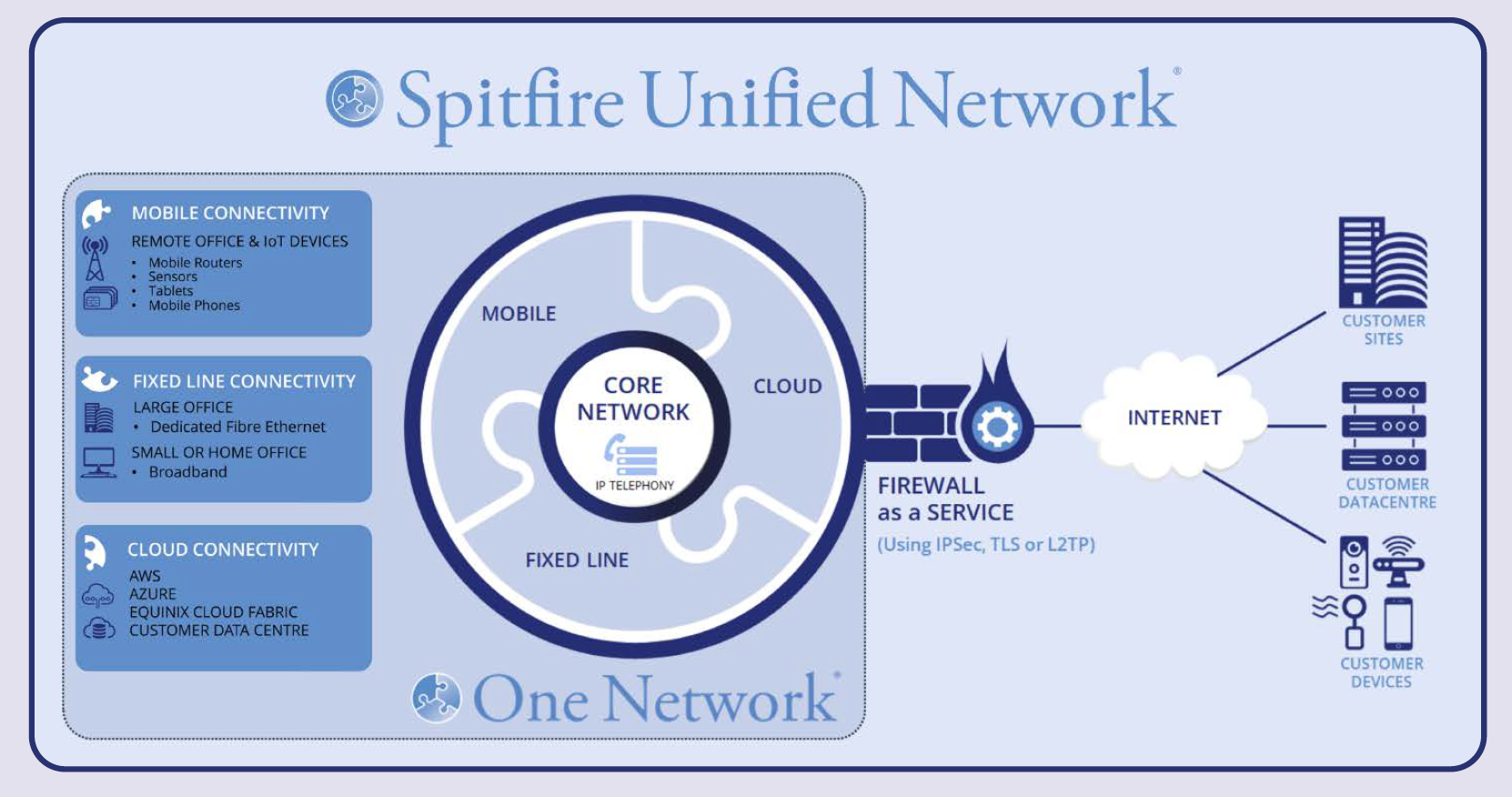
An Overview of Spitfire’s One Network Private network solutions, like Spitfire’s One Network, offer a modern approach to IoT connectivity by keeping devices hidden from the public internet and minimising the risk of unauthorised access. Rather than using public IP‑based solutions with their associated vulnerabilities, a private network places all connected devices within a secure, protected network environment.
Spitfire’s One Network:
A superior solution Spitfire’s One Network offers a transformational solution for connecting, monitoring, and managing any size estate of IoT devices. A fully private network, it eliminates traversal of the public internet, significantly reducing exposure to cyber threats and shielding sensitive data from interception or unauthorised access.
Until now, deploying a robust IoT solution has usually called for multiple connectivity supplier relationships involving complex integrations and management, with the added vulnerability of data traversing the public internet.
One Network seamlessly integrates mobile, fixed-line, and cloud connectivity into a unified, secure private MPLS network under a single end-to-end supplier relationship.
Enhanced Mobile Connectivity: As a full MVNO we have complete control and flexibility over configuration, provisioning, pricing and support.
With options for ‘home’ and multinetwork, complete UK geographic coverage, redundancy, and diversity to ensure devices can connect securely from anywhere.
Fixed Line and Cloud Integration: Seamless integration with fixed-line fibre circuits and cloud environments like AWS and Microsoft Azure, avoiding the need for data to traverse the public internet at any point within the network.
Future-Proofing with IPv6: As the limitations of IPv4 become more apparent, Spitfire’s Enhanced Mobile configurations enable the use of private IP addresses while supporting the transition to IPv6 for more scalable IoT networks.
Key Benefits of One Network:
Enhanced Security: Devices remain off the public internet, significantly reducing the attack surface and the risk of any unauthorised access.
Operational & Cost Efficiency: It eliminates the need for multiple public IP addresses, network configuration, and maintenance, lowering operational expenses.
Scalability and Simplicity: Simplified management and faster network deployment with potentially no configuration required by the end-user, allowing for easy scaling with minimal hardware requirements and reduced data overheads.
Sustainability: The ability to deploy devices with less powerful processors and lower energy consumption aligns with many organisations’ sustainability goals.
By shifting to a private network solution like One Network, businesses can ensure enhanced security, improved operational efficiencies, cost savings, and better service delivery in IoT and other use cases.
To find out more visit: www.spitfire.co.uk


Be First to Comment