
….provided an opportunity to learn about trends in the AV market through the prism of Sony’s product portfolio. James Goulding reports
 The design of Sony’s stand at ISE paid homage to sustainability and the company’s Japanese heritage with an organic paper and wood aesthetic, but it was the company’s new displays, production studio and industry partnerships that caught the eye. We started our tour with Sony’s new Crystal LED displays – the BH Series (optimised for brightness) and the CH Series (optimised for contrast).
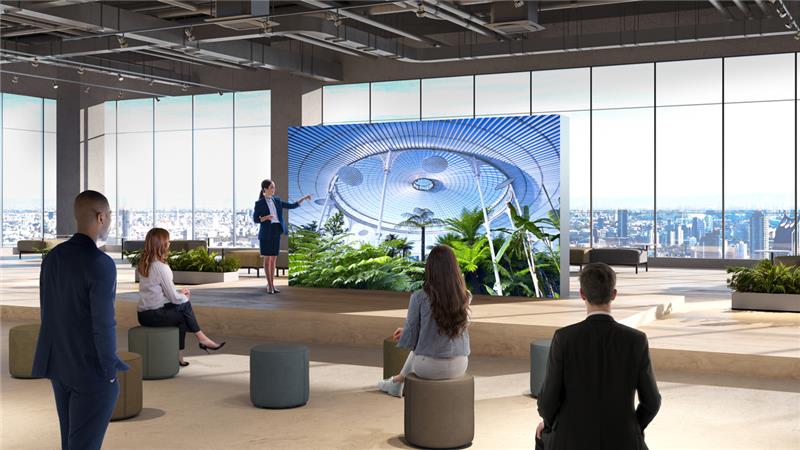
These super-bright modular LED panels, available with a pixel pitch of 1.2 or 1.5mm, provide the building blocks of LED video walls that can be expanded to create the super-size, immersive experiences that were such a feature of ISE 2023. Dover highlighted the panels’ energyefficiency, modularity, configurability and serviceability. “This is a completely modular system – it is made up tile by tile – and it is completely configurable, so you can adjust individual elements of each tile. The beauty of this, which a lot of other manufacturers can’t achieve, is that it enables us to cross-match supply. Typically, with LED, if you wanted to extend your display at any point you would use panels from the same production batch to get the required level of accuracy.
Because we can colour calibrate these panels to match a display exactly, you can use panels from a completely different batch to the original, which reduces the need to hold additional modules as spares.” He added that Sony’s new BH and CH Series also have benefits for installers and maintenance providers. “
They are surface-mountable and frontserviceable, so there’s no need for scissormechanisms that allow you to make adjustments from behind, and you don’t need to turn off the display to replace a panel, unlike previous generations that require you to replace and reboot.” The model showcased by Sony was a 220in BH-series 4K 1.2mm Crystal LED display enhanced with LA1 line array speakers – four speakers on either side and six above the display – which Dover says helps organisations attract attention and provide more experiential engagements, in retail for example.
“It’s difficult to find an audio solution for LED screens because traditionally you’d have audio coming from behind the screen. These line array speakers allow you to completely control the beam of sound so that you can angle it to suit the installation and the desired listening environment.
Having an audio solution for an LED is quite unique and what we’ve noticed from having it at the front of the stand is that 99% of people walking past, hear the audio and stop and watch. It helps capture their attention.” Sony’s Crystal LED displays have numerous applications, from eye-catching centrepieces in reception areas and boardroom installations for viewing Excel and PowerPoint in great detail to more immersive deployments in retail and virtual production installations, where the display can act as a virtual backdrop for content creation.
Virtual production Elsewhere on the stand, Sony was demonstrating its Crystal LED Virtual Production System Solution, comprising a 137in Crystal LED B-series display and VENICE cinema camera, alongside a camera tracking system and real-time engine. “It’s technically a complete Sony ecosystem,” explained Dover. “Colours on the display are identical to how they look on Sony BVM post-production colour grading monitors because Sony has that understanding of how to process images correctly and accurately on screen. We call it ‘from lens to living room’. In the US, it’s ‘from camera to couch’. It gives customers reassurance that they can trust the brand.” He added that virtual production/postproduction is a big growth area for Sony. “
We just did an installation in France with an LED wall 19 metres wide by 8 metres high, which is used to film movies, advertisements and other content. The studio leases out the space so brands can film whatever they need to, without having to travel to a location and incur the cost of moving people and equipment around. If you need to reshoot anything, you just find a screen and you’re there.” Bread and butter In enterprise AV, Sony is best known for its Bravia brand of professional displays – another big growth area. Dover describes them as Sony’s ‘bread and butter’ and estimates that they now outsell the company’s projectors by a ratio of more than 2:1. “
 In B2B, probably 65% to 70% of sales come from Bravia panels. Projection was always the go-to because you could get really big image sizes and flexible installations, but now panel sizes are getting ever bigger, the cost is coming down quite substantially and you have much more flexibility when it comes to the installation of larger panel sizes.”
That aside, Dover points out that projector sales have been relatively stable over the last few years and, more than 50 years after Sony entered the projection market, remain a big part of the company’s business. “In education, projection is key because of what it offers for classrooms and lecture halls. You’re not going to put an LED wall in a lecture theatre because of the price, whereas projectors are a really cost-effective way to get that big screen solution.
Small meeting rooms are making the transition to screens, but larger meeting rooms are still wedded to projection because of the size and brightness that’s required in those environments.” In addition to the brightness of their output, laser projectors offer reduced maintenance requirements (no lamp changes) and useful features like an ambient mode that adjusts brightness according to light levels and auto switching and HDMI signal detection. Comprehensive line-up Returning to the subject of Bravia displays, Dover cited the breadth and depth of Sony’s offering as a major attraction.
“I think we have the most comprehensive size line-up of all manufacturers. We have a 32in 4k right the way up to a 100in 4k and across that we have two different ranges. Our professional range is the BZ series and within that we have our BZ30 line-up and our high-end BZ40 line-up. BZ30s are IPS panels and their wider viewing angle makes them more suitable for retail and signage, whereas the BZ40 is more of a meeting room solution because you’re generally going to be sitting front and centre and will want slightly higher brightness.”
Other selling points of Sony Bravia displays are their picture quality; warranties (return to base or swap-out options, with three-year cover as standard and the option to buy a two-year extension); service & support, including dedicated pro service teams and an escalations line for resellers; and time-saving installation tools, like the new Bravia Supervisor app which remotely configures displays as soon as they are connected to the network.
“When an installer gets 20 screens for setup, they can upload the serial numbers and individual configurations in their Bravia Supervisor GUI and then, as soon as those devices are connected to the network, they are automatically configured whether that’s for a meeting room, where you might only want the Bravia Meeting Room solution and the HDMI to be accessible, or a simple signage configuration, where the display is completely locked down.
What we’re trying to do is empower integrators to find more efficient ways to manage their installations.” TEOS Complementing its Bravia displays, Sony offers a broad ecosystem of solutions, including the TEOS suite of workplace management tools (available in onpremise and cloud versions), introduced by Sony about five years ago.
“TEOS is an AV over IP control monitoring solution that gives visibility of network devices in one central location. Instead of having to turn on everything in the morning and spend 45 minutes walking around checking there aren’t any problems, TEOS gives you a quick view of the status of meeting rooms. If the traffic light identification signal is red, your facilities or AV manager can go to the meeting room or location in question and fix the problem.
“Within that workspace solution we also have room booking, TEOS Book; we have TEOS Reception, which is a virtual reception solution that can act as a standalone virtual reception solution or complement an existing setup; we’ve got signage and wayfinding; and we have TEOS Meet that lets you book services, such as catering, from the meeting invite.” Soon, Sony will be adding support for sensors and IoT devices bringing more automation to the working environment.
TEOS works natively with all Sony technology and Sony also provides TEOS players, which enable third party devices, whether that’s an NEC/Sharp display or Samsung tablet, to work natively with TEOS. This means that customers can upgrade their workspace management solution to TEOS and keep their existing displays. There are currently around 4,500 installations of TEOS across Europe, including the full enterprise solution and TEOS Lite, an entry level version for SMBs. AI Another solution highlighted by Dover is Sony’s Edge Analytics appliance (the REA-C1000) or ‘magic box solution’ as he calls it. T
his provides a variety of capabilities for more impactful and informative presentations, including handwriting extraction technology, which ensures that text written on a board is visible and not obscured by the presenter even when they are standing right in front of it, and a Chromakey-less CG Overlay feature (like a green screen) for the high impact presentation of supporting materials. At ISE, Sony was demonstrating Edge Analytics in an education setting in conjunction with its new AI-powered PTZ cameras, the SRG A40 and the SRG A12.
Auto-tracking keeps the presenter centre-screen at all times, ensuring remote participants don’t lose sight of them as they move around. “These cameras have the most advanced auto tracking we’ve seen and different ways of processing data. For example, you can configure it to show full body or upper body and head.
It’s got facial recognition and it does a level of skeletal analysis. As the lecturer moves around it tracks them very smoothly and gently. If they leave the scene, it automatically resets the centre. If a new target comes in, it won’t pick them up unless that’s what you specify, but it will automatically pick up the old target if they come back and start where they left off.” Partnerships Solutions are an increasingly important differentiator for Sony that add value to sales, enhance workplaces and meet changing customer requirements.
As well as developing its own solutions, Sony is partnering with a growing number of third parties to enable them to run their solutions natively on the system-ona- chip (SoC) platform embedded within Sony hardware. Among examples highlighted by Sony were Kramer BRAINware cloudbased control and space management software, which can be used to control each individual element within a meeting room, including Bravia displays and Sony projectors; and, on the content management side, a new partnership with signageOS that makes it easier for all digital signage content management system (CMS) providers to deploy their solutions on Sony hardware without the need for additional hardware, such as an external media player.
Sony is already well known for the quality of its hardware and now, with the development of a broader ecosystem around its Bravia displays, it is strengthening its value to B2B channel partners and vendor partners.


Be First to Comment